When a white or light-colored silicone phone case turns yellow or darkens after use, buyers often hear a vague explanation: “All light-colored materials turn yellow.” That answer does not show where to investigate. For the next production run, the useful first step is to distinguish discoloration in the silicone body from discoloration in the soft-touch coating or surface staining. The investigation can then move to the silicone compound, cure system, pigments, post-curing or coating process, and storage conditions.
Confirm the case material before starting the diagnosis. Many highly transparent soft cases on the market are made from TPU, and common aromatic TPU follows a different yellowing mechanism from silicone rubber. Silicone cases are usually matte, translucent, or opaque. A supplier page that calls a product a “soft case” is not proof of the material, so the purchasing specification should state the material system. This article covers silicone phone cases only and does not discuss TPU in detail.
First Diagnose the Source: Silicone, Coating, or Contamination
The three types of discoloration can look similar, but each requires a different response. Surface staining is often concentrated in frequently touched areas and may become less visible after cleaning. Aging of a soft-touch oil coating or another coating typically appears as a darker, tackier, or uneven surface, while a cut edge or uncoated area may retain its original color. Discoloration in the silicone body extends through the rubber layer; wiping the case cannot remove a color change inside the material.
When a complaint sample arrives, first clean an area that will not affect the evaluation, then compare the sample with the retained approved sample under the same light source. Next, inspect the cut edge, inner surface, and outer surface to determine whether they changed together. If only the exterior has changed, first check the coating batch, pretreatment, bake conditions, and materials that contacted the case during use. If the inside, outside, and cut face have all changed, check the compound, color masterbatch, curing, and post-curing records. Without this distinction, replacing the curing agent cannot solve coating discoloration, while preparing a new coating cannot correct color change in the silicone itself.
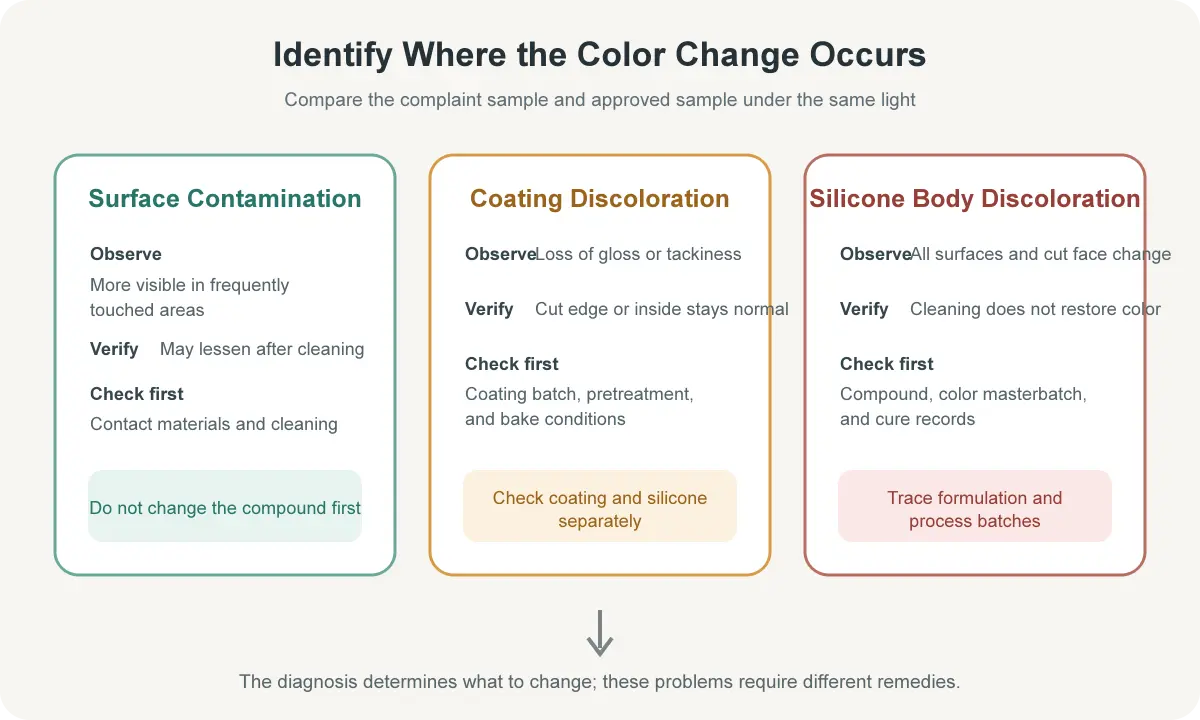
Cleaning may reduce surface staining. Once a coating or silicone body has actually changed color, however, toothpaste or baking soda will not normally restore it to its factory condition. For a brand buyer, controlling the source and ensuring that production batches reproduce the approved sample is more effective than relying on after-sales cleaning.
How Materials and Formulation Affect Color Stability
A silicone case passes through compounding and mixing, compression molding and curing, trimming, any required post-curing, surface treatment, and inspection. Every stage can introduce a color variable, but these variables should not all be grouped under the vague label of “poor material.”
The first group of variables comes from the cure system. Solid High-Consistency Rubber (HCR) can use either Peroxide Cure or Platinum Cure, also called Addition Cure. Peroxide decomposition initiates crosslinking and produces byproducts. If the formulation, degree of cure, or post-curing conditions are unsuitable, residual low-molecular-weight substances may contribute to odor and later color change. Platinum Cure produces fewer byproducts, but it is more sensitive to sulfur-, phosphorus-, and amine-containing contaminants. Cure inhibition caused by these substances can lead to tackiness, undercure, or batch irregularities.
The second group comes from the base polymer, reinforcing filler, and mixing process. Impurities in raw materials, variations between silica and structure-control-agent batches, cross-contamination from equipment, and uneven color-masterbatch dispersion can all cause fluctuations in whiteness and aging resistance. Fumed silica-reinforced silicone, commonly called “fumed silicone,” and precipitated silica-reinforced silicone, commonly called “precipitated silicone,” describe only part of a formulation. A product name alone cannot prove that the finished case will resist yellowing. Buyers should evaluate the approved sample, batch controls, and test results.
The third group comes from the color system. White compounds normally use titanium dioxide for opacity. A weather-resistant rutile titanium dioxide grade with a suitable surface treatment is generally a better choice than an anatase titanium dioxide for outdoor use or prolonged light exposure, but the final result also depends on dispersion, dosage, and the complete formulation. A small amount of ultramarine blue can use blue-yellow color compensation to improve the initial shade of white and make it look cleaner. This is color correction, not a way to stop material aging. Treating “whiter at the start” and “less likely to yellow over time” as the same requirement is a common mistake in white-case formulations.
The fourth group comes from heat, light, and contact conditions. Ultraviolet exposure and high temperatures accelerate the aging of organic components. During storage, prolonged contact with solvent vapors, amines, sulfur-containing materials, or unsuitable packaging may also cause contamination or color migration. The same formulation can therefore produce different results under different packaging, shipping-temperature, and shelf conditions. When assessing a formulation, tell the supplier the target market, expected service temperature, and packaging method.
Peroxide vs. Platinum Cure: How to Choose
The choice between Peroxide Cure and Platinum Cure depends on the balance among cost, processing window, cleanliness, and finished-product performance. Peroxide cure is well established in solid-silicone compression molding. With a compatible formulation, sufficient cure, and post-curing completed according to product requirements, it can also be used for white and light-colored parts. “Double 2.5” is only a workshop nickname for a peroxide curing agent. The purchasing specification should record the supplier’s product grade or technical data instead of relying on that nickname. It should also state whether the finished part requires post-curing and how the actual temperature and time will be validated.
Post-curing is an oven treatment carried out after molding. It is not a third cure-system option at the same decision level as Peroxide Cure and Platinum Cure. It is commonly used to complete further crosslinking, reduce volatile substances, and remove some peroxide byproducts. Some compound suppliers specify typical conditions of 200 °C for 2–4 hours, but those conditions are only references for the relevant compounds and products. They should not be copied directly to every phone case. Part thickness, color system, oven ventilation, loading density, and the compound supplier’s recommendations all affect the appropriate settings. Excessive temperature or time can also change color and performance.
Platinum Cure has the advantage of producing fewer byproducts and can suit projects with stricter odor, cleanliness, or light-color appearance requirements. Its cost is not limited to the compound itself; production-environment control and raw-material compatibility must also be managed. Sulfur, phosphorus, some amines, and certain pigments or release materials may inhibit the platinum catalyst. Switching to a platinum system will not automatically produce stable mass production if contamination has not been isolated.
Liquid Silicone Rubber (LSR) normally uses platinum cure, and solid silicone can also use an addition-cure system. Neither LSR nor Platinum Cure alone guarantees long-term color stability. The material route changes the sources of risk, but it cannot replace controls for the color masterbatch, coating, production environment, and aging validation.
Four Formulation Checks for White and Light-Colored Cases
First, confirm the base polymer and filler system. Require the supplier to record the compound grade or a mutually approved formulation code. The raw-material grade or supply source should not be changed in production without approval. Buyers do not necessarily need the complete proprietary recipe, but they do need traceability showing whether the production goods and the approved sample follow the same technical route.
Second, confirm the curing and post-curing conditions. State whether the system uses peroxide or platinum. Where post-curing is required, specify the project standard for temperature, time, ventilation, and loading. Writing only “post-cured” is insufficient, and settings issued by a supplier for a different compound or product should not be applied directly to the current project.
Third, confirm the pigment and stabilization system. For a white project, ask whether the titanium dioxide and color masterbatch are suitable for the target light-exposure conditions. For a light-colored project, make actual parts and verify the pigments’ heat resistance, light resistance, and compatibility with the cure system. Whether to use a UV absorber, a hindered amine light stabilizer (HALS), or an antioxidant system—and how much to use—should be evaluated by the compound and additive suppliers in relation to any food-contact requirements, coating, and cure system. Excessive additives may cause exudation or bloom and may also reduce adhesion in later bonding or printing operations.
Fourth, manage the coating separately. For a case with a soft-touch coating, approve the silicone-body color and coating color separately. Record the primer, topcoat, bake conditions, and coating batch. If only the coating loses gloss or changes color after aging, changing the silicone formulation will not correct the defect. If both the silicone body and coating change, investigate them separately.
All four checks must ultimately become batch controls. Sampling may involve only a few parts, while mass production can span several mixing batches, curing shifts, and coating batches. Compare the production first article with the approved sample under the specified light source, and retain color-measurement data and process records for critical batches. If a deviation occurs, these records make it possible to trace the cause to mixing, curing, post-curing, or coating instead of concluding only that “silicone turns yellow.”
Write Yellowing Resistance into Sample and Purchase Specs
“The white case must not turn yellow” is not an acceptance criterion. A more reliable specification defines the sample, exposure conditions, measurement method, and allowable change before setting the pass/fail limit.
| Purchase-Spec Item | What to Define | Commonly Missed Detail |
|---|---|---|
| Material and cure route | Silicone type, formulation code, peroxide or platinum system, and whether post-curing is required | Writing only “food grade” or “good material” without batch traceability |
| Color reference | Physical approved sample, measurement illuminant and viewing conditions, and initial color data | Arguing visually about whiteness under different lighting |
| Aging conditions | Exposure method, lamp type, irradiance or cycle, temperature, duration, and sample position | Writing only “test for 500 hours” without the complete conditions |
| Evaluation method | Before-and-after photographs, color difference or yellowness index, appearance and coating condition, and the agreed limit | Copying a limit from another product without validation for this project |
| Production control | First-article comparison, sampling frequency, compound and color-masterbatch batches, and cure and coating records | Allowing unrestricted material substitutions after the sample passes |
ASTM G154 and ISO 4892 are common laboratory light-aging exposure methods, but citing a standard name does not define the lamp, cycle, temperature, duration, or project pass/fail limit. Likewise, color difference ΔE and the change in yellowness index ΔYI are measurement results, not universal acceptance thresholds. The acceptable change should be agreed upon according to the target market, color, expected service period, customer tolerance, and approved sample. Comparing candidate formulations first and then setting an internal limit from a satisfactory sample is more reliable than copying a generic limit that has not been validated for the project.
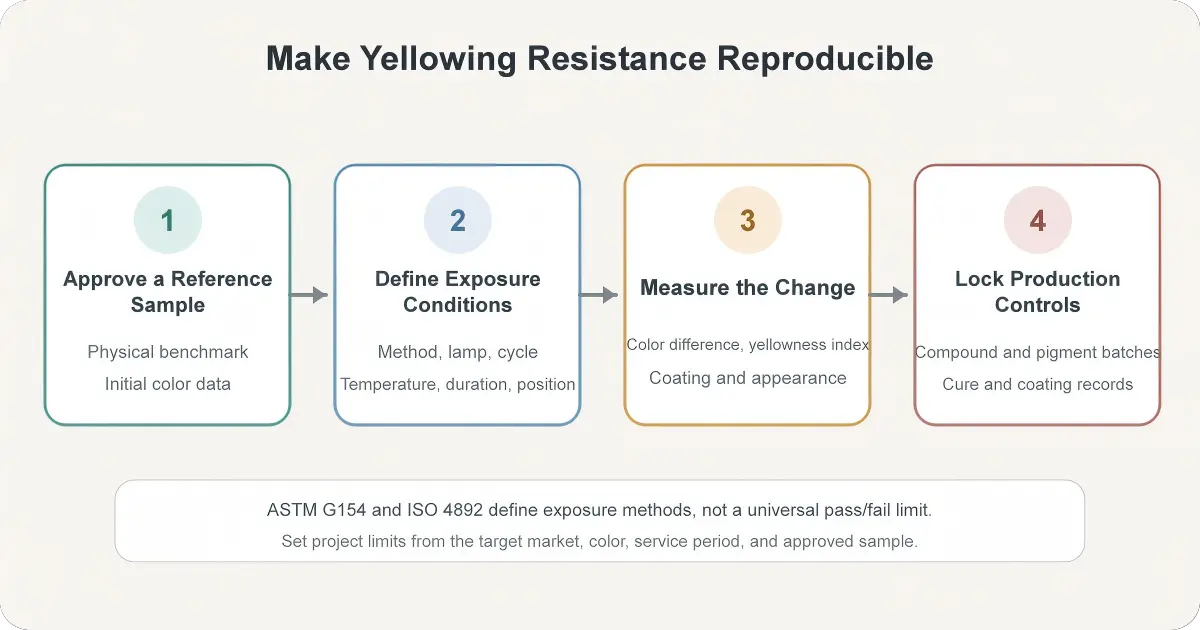
If a project does not yet have an acceptance limit, age two or three candidate solutions together. One set can use a peroxide system with its specified post-curing conditions, another can use a platinum system, and further sets can compare different color masterbatches or coatings where necessary. Use the same structure, thickness, color, exposure conditions, and measurement method for every sample. The buyer is not choosing the material name that sounds most advanced; the buyer is choosing the combination that can be reproduced consistently at the target cost.
Develop a white or light-colored silicone case along one controlled path: identify the layer that changed color, select the compound and cure route, validate the color and coating systems, and manage production through approved samples and batch records. YueHouDZ supports Custom silicone manufacturing projects during solid-silicone compression molding trials by helping brands align the formulation code, process records, and approved sample for later retesting and traceability.