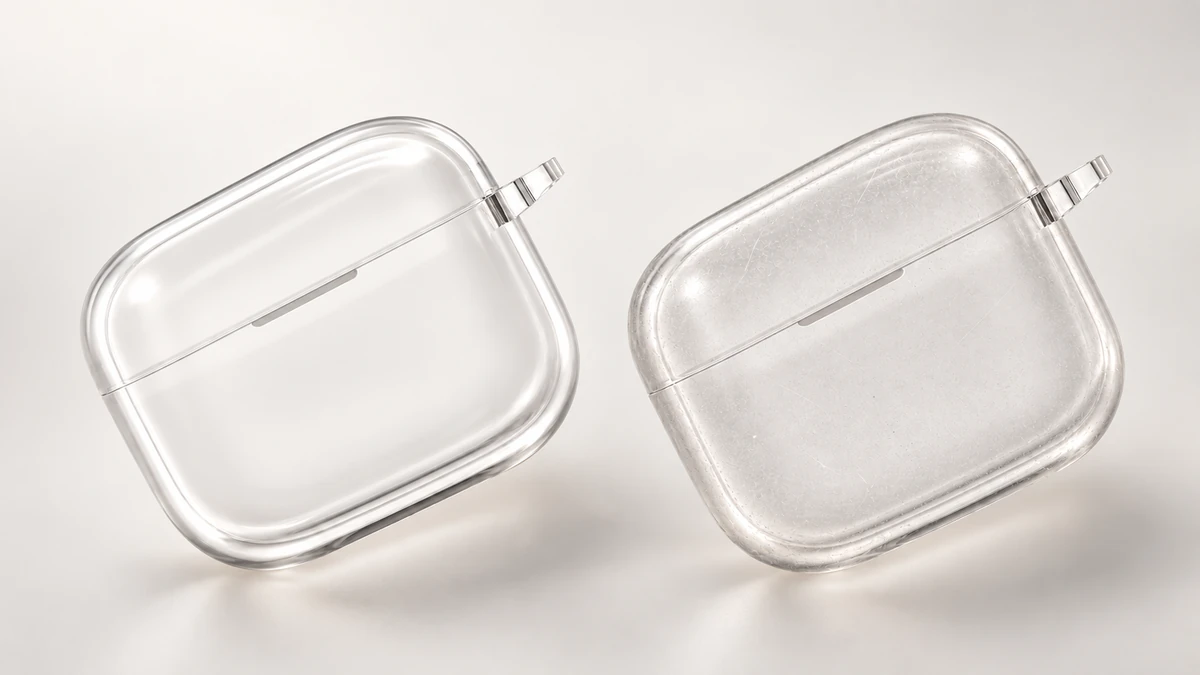
A transparent Silicone Case may look clear when it first leaves the mold, pick up a ring of dust after packaging, then feel rough or tacky after several days of handling. Under a lamp, it may also appear covered by a milky veil. These are at least four separate issues: dust pickup, tackiness, haze, and scratch visibility. They can occur together and amplify one another, but a loss of clarity does not make them the same problem.
A useful investigation does not begin by guessing whether the silicone compound, silicone oil, or coating is at fault. It begins by preserving the observed condition, then testing the base material and the surface treatment within the same sample set. If that order is reversed, a sample may appear to improve only because the symptom was temporarily wiped away or concealed, making the result difficult to reproduce in the next batch.
Clear at Demolding Does Not Mean Stable Later
The appearance at demolding answers only one question: does this sample look clear under the lighting, temperature, and cleanliness conditions at that moment? It does not show what will happen after contact with packaging, skin oils and perspiration, cleaning agents, friction, and repeated handling.
Start by separating the terms. Dust pickup means particles remain easily on the surface. Tackiness describes how the surface feels to a finger. Haze means transmitted light becomes whitish and more diffuse. Scratch visibility means fine scratches become more noticeable at certain viewing angles. Dust and scratches can make a milky appearance more obvious, but that does not prove that the silicone has whitened internally. A tacky feel alone also does not prove that an ingredient has migrated to the surface.
An initial photo and a single touch check are therefore only baseline records. Before approving the sample, ask when the problem appeared, which surface or area is affected, whether cleaning restores the appearance, and whether comparison samples from the same batch show the same change.
Start with Timing, Then Check Location and Cleanability
Trace the problem backward along the usage timeline. Tackiness immediately after demolding should not be grouped with dust pickup that begins only after packaging. Haze after several days of use is also a different scenario from whitening that appears suddenly after washing. Placing photos, tactile observations, and before-and-after cleaning records on a timeline eliminates many guesses early.
Next, record the location. Track the frequently touched outer surface, the inner contact surface, edges, corners, and broad flat areas separately. If the milky appearance occurs only where hands regularly touch the part, investigate contact materials and cleaning recovery first. If it follows an area compressed by the packaging, include the packaging material and storage conditions in the investigation. If the entire part lacks clarity from the beginning, return to the compound, molding conditions, and mold surface. This is an investigation order, not a rule that assigns a cause from location alone.
Cleaning tests also need a control. Clean one defined area with an agreed method and leave another area untouched, then record the immediate result and any change after storage. If the mark can be removed, surface contamination deserves further investigation. If it cannot be removed, that only shows that loose dust is not the entire problem; it does not justify jumping directly to material aging or coating failure. The cleaning agent, wiping material, applied force, and number of strokes must remain consistent, or results from different operators cannot be compared.
Add a flat witness specimen as well. Make it from the same silicone batch and with the same surface treatment as the curved case. The flat specimen supports visual checks and instrument measurements, while the curved finished part represents the actual appearance and feel. Each serves a different purpose: the witness specimen cannot replace the finished part, and one reading from a curved surface cannot replace a material assessment.
A Milky Appearance Does Not Always Mean the Silicone Has Whitened
Visible haze may come from the surface, fine scratches, texture, or light scattering within the material. Before drawing a conclusion, change the lighting and viewing angle, clean a defined local area, and compare the curved part with the flat witness specimen. If the milky appearance becomes more obvious together with scratches as the angle changes, check the surface condition first. If cleaning causes a large difference, trace the contact material. If both the witness specimen and the finished part show a stable change, there is a stronger reason to examine the compound and molding conditions.
Do not keep only one “problem photo.” Photograph the same case against a fixed background, under fixed lighting, and at a fixed viewing angle before testing, then add a side-lit image. The first image supports comparisons of overall clarity; the second makes surface deposits and fine scratches easier to see. If the phone, lamp, and angle change each time, a brighter or whiter appearance may come from the photography itself, and even a large set of images will not prove that the sample changed.
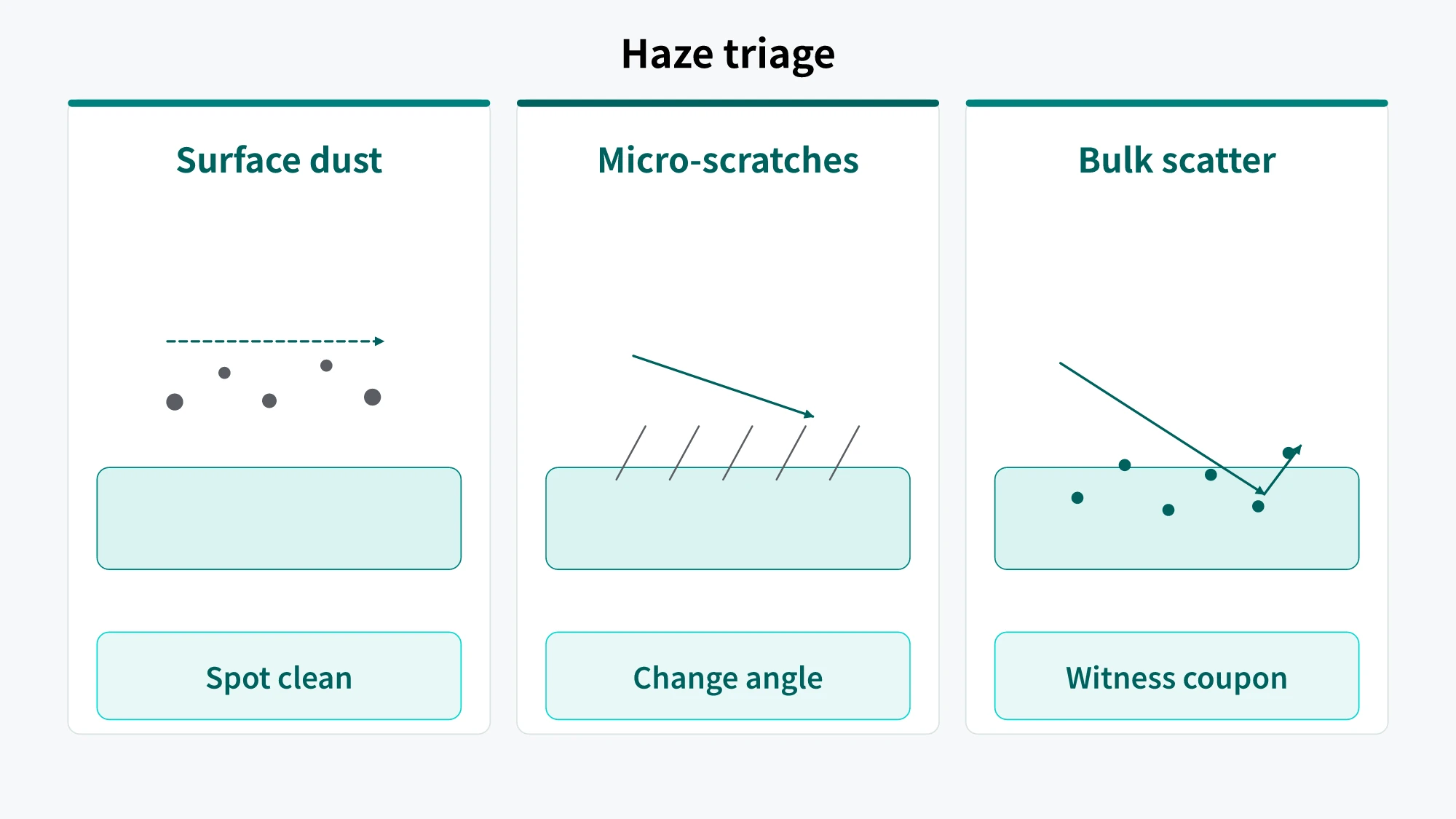
Haze and total light transmittance are not the same measurement. A sample may transmit a substantial amount of light yet look hazy because scattering has increased. Store each result together with the specimen geometry, thickness, surface condition, and test conditions. Most clear silicone cases are curved, so the ASTM D1003 method for flat specimens should not be applied directly to the case and then treated as a horizontally comparable result. When instrument data is required, use an agreed flat witness specimen and continue evaluating the finished case for its actual appearance.
How to Test the Material and Surface Together
A surface treatment can change tactile feel, dust pickup, and appearance, but it cannot answer every question about the base material. Testing only untreated silicone does not show how the surface treatment will perform after cleaning and friction. Testing only treated samples may hide differences in the material itself. A more reliable approach is to compare untreated and surface-treated samples made from the same silicone batch, in the same mold, and under the same molding conditions.
When YueHouDZ defines development inputs for transparent silicone protective parts, we include the compound, mold surface, post-processing, surface treatment, and sample grouping in the same Custom silicone manufacturing trial plan. This does not assume that a particular process is at fault. It provides a traceable comparison whenever one variable changes.
| Sample to Compare | Initial Check | After Packaging or Storage | After Use Simulation | Check Again After Cleaning |
|---|---|---|---|---|
| Untreated curved case (uncoated sample) | Clarity, tactile feel, visible defects | Dust locations, contact marks | Frequently touched areas, edges, fine scratches | Whether it recovers and whether marks remain |
| Surface-treated curved case | Changes in appearance and tactile feel | Changes at packaging contact areas | Evaluate tactile feel, dust pickup, and appearance together | Whether the surface remains consistent after cleaning |
| Untreated flat witness specimen | Save baseline readings and photographs | Store for the same period as the case | Expose under the agreed conditions | Retest and retain the original specimen |
| Surface-treated witness specimen | Record beside the untreated specimen | Compare under the same conditions | Check changes in appearance, tactile feel, and resistance | Retest, then compare again with the finished part |
Record dust pickup, tactile feel, transparent appearance, and the effect of cleaning for every sample. A smoother feel alone does not prove cleaning resistance, and short-term freedom from dust does not prove that haze will not develop later. Post-curing is a second heat treatment after molding and demolding. Mold surface condition means the finish or texture of the cavity surface that directly contacts the silicone. Post-curing, mold surface condition, and surface treatments such as a tactile coating can all be included as test variables, but none is a universal fix. Test conditions must come from the actual use and packaging scenario; without that basis, do not invent a cycle count or service-life figure.
Release Only What the Evidence Supports
One acceptable appearance check proves only that the initial sample passed. A judgment becomes more reliable when comparison samples from the same batch repeatedly produce the same result. The next steps are packaging-contact testing, use simulation, cleaning and retesting, and confirmation that the result can be reproduced in a new batch. A release statement must match the tests that have actually been completed. If only a same-batch comparison has been performed, report only that result. Add conclusions about packaging contact, simulated use, or batch-to-batch reproducibility only after those tests are complete.
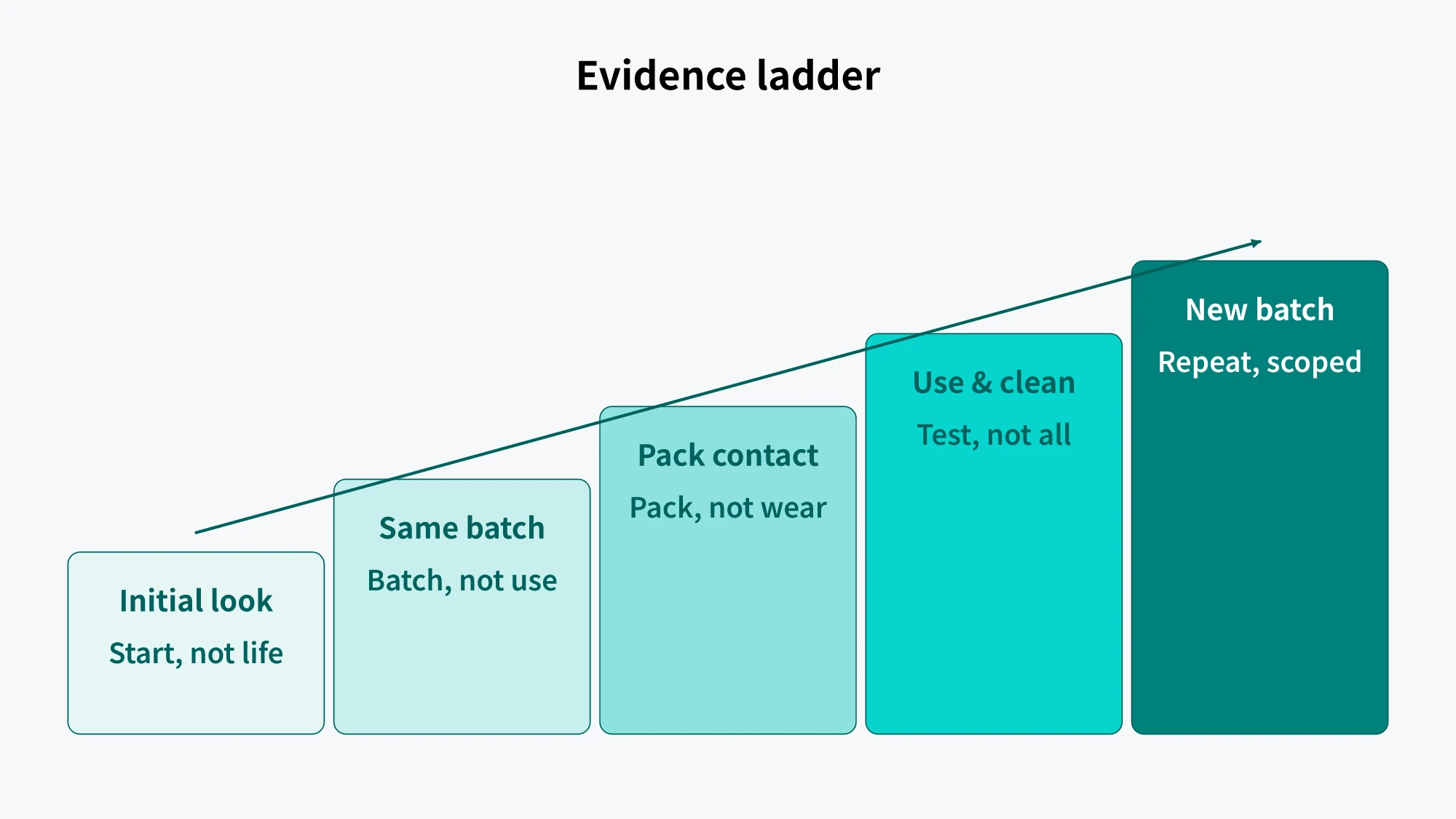
If the issue occurs with only one surface treatment, add the corresponding cleaning-resistance, friction, and appearance checks. If untreated and treated samples change together, review the compound, molding, mold surface, and post-processing records. If the result appears only at a specific packaging contact point, retain that contact sample separately. When evidence is incomplete, the correct conclusion is “additional testing required,” not a claim of long-term stability based on one successful cleaning.
The release decision can be written plainly. If the initial sample has an obvious defect, revise the sample first. If the initial sample passes but packaging-contact or use-simulation testing is incomplete, mark it as pending further testing. Move to reproduction in the next batch only when grouped samples give consistent results under the agreed conditions. If untreated and surface-treated samples move in opposite directions, do not average them into one “overall pass.” State what happened to each group and which evidence is still missing.
A sample release record should preserve at least four items: the sample groups, treatment conditions, before-and-after photographs, and the reason for the decision. If dust pickup or haze returns later, the team can then compare the same condition instead of debating whether the previous sample “seemed clearer.”
Frequently Asked Questions
Does dust pickup on a clear silicone case mean its surface energy is too high?
That cannot be concluded from dust pickup alone. Whether particles remain also depends on surface condition, contamination, contact mode, and the use environment. Compare untreated and surface-treated samples from the same batch before drawing conclusions about the material or surface treatment.
If cleaning removes the haze, can the sample be released immediately?
Not yet. Recovery after cleaning only shows that surface deposits contributed to that occurrence. It does not replace packaging-contact testing, use simulation, or results after repeated cleaning. Keep an uncleaned control area and observe whether the condition returns after storage.
Is there one universal pass value for “no dust pickup”?
In the publicly available ASTM and ISO standard catalogs and test methods reviewed for this article, we did not find one universal “no dust pickup” acceptance value that can be applied directly to clear silicone cases. Individual projects may still have customer-specific requirements. A more reliable method is to define sample groups, observation methods, and acceptance rules from the actual use conditions, then cross-check the flat witness specimen against the curved finished part.