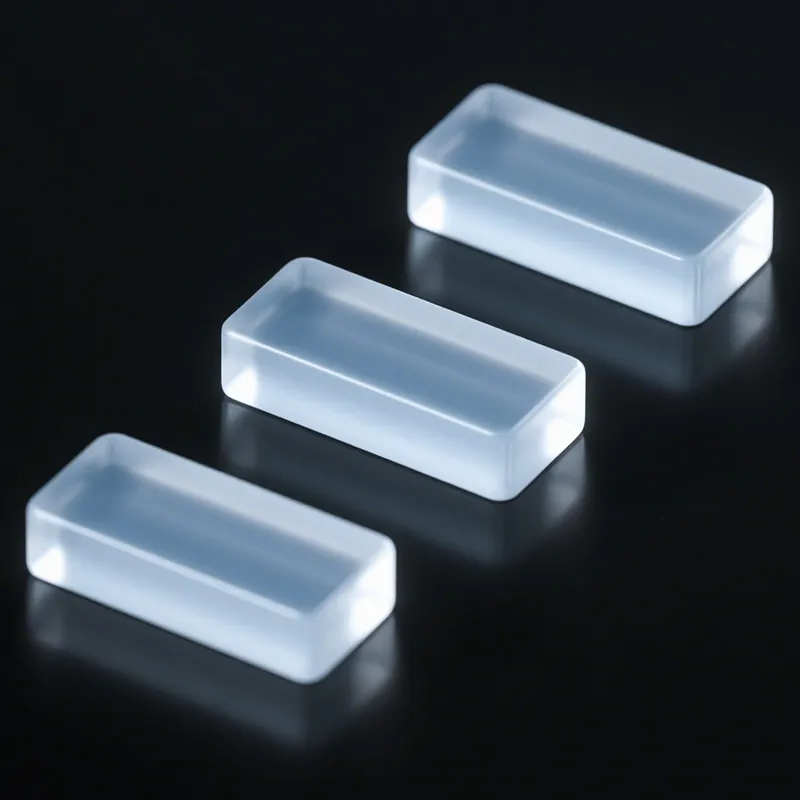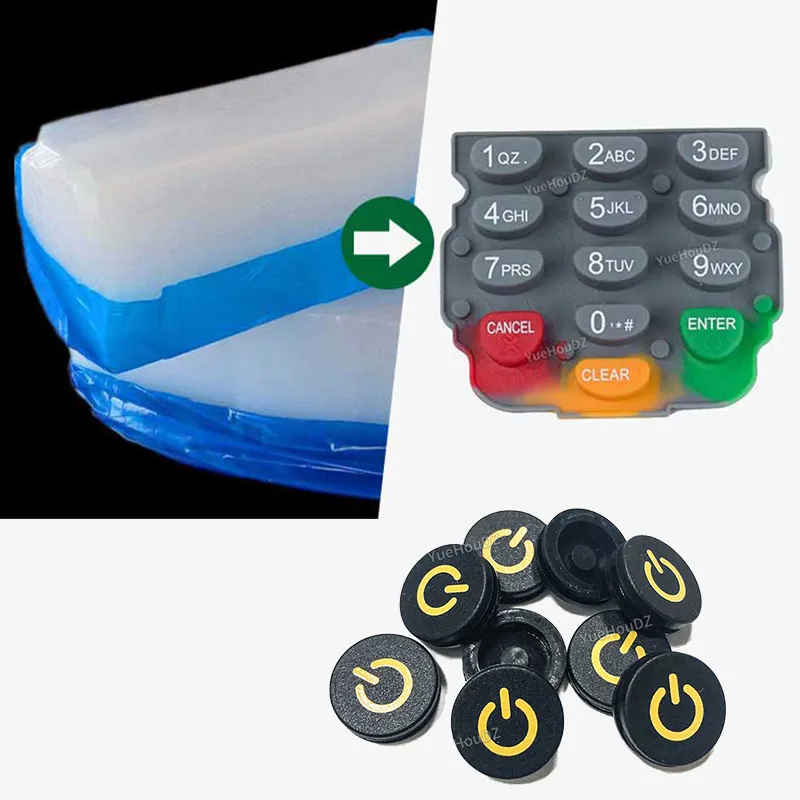
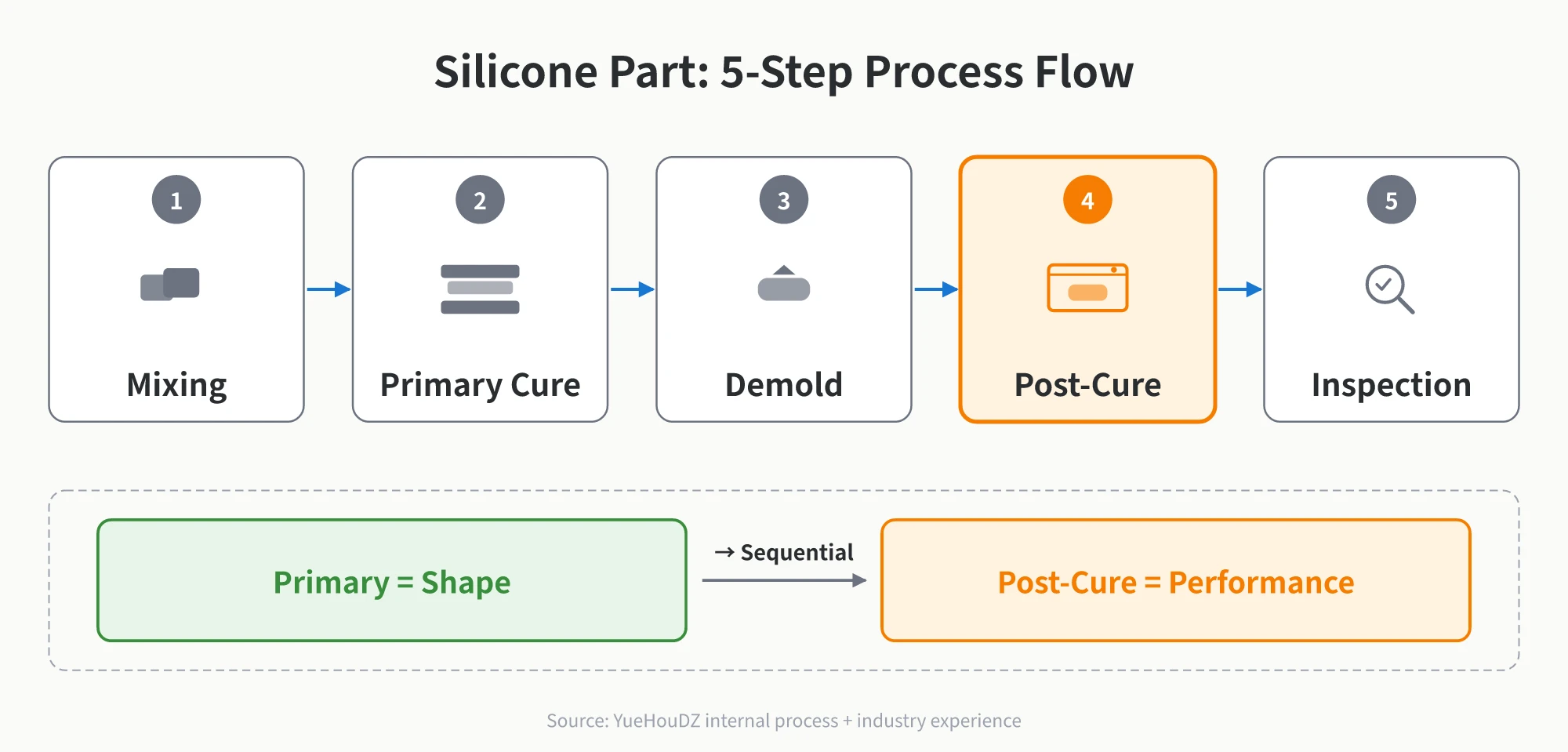
When a silicone part comes out of the mold, its shape is already set, and it can be handled and used. So why does it still need to go into an oven for another 2 to 4 hours? This secondary vulcanization step, also called post-curing, is not added just to fill production hours. In a peroxide-cured system, it is a necessary step. Primary vulcanization sets the shape. Secondary vulcanization stabilizes the material properties. The first step forms the part, and the second step locks in performance. They are sequential steps, not two alternative options.
YueHouDZ makes HTV solid silicone compression-molded parts. DBPMH is the main curing agent used in this process, as it is the standard peroxide curing agent for HTV silicone. The mechanisms, process parameters, and decision points below all follow that route. This article does not cover LSR liquid silicone rubber or platinum-cured systems. In the silicone industry, the correct term is “vulcanization,” not “curing.” “Curing” is used for materials such as epoxy and polyurethane. Silicone uses “vulcanization.”
What Secondary Vulcanization Changes
Secondary vulcanization is more than just heating the part one more time. After primary vulcanization, the green part goes into a 200 °C forced-air circulating oven. Three things happen at the same time.
First, the hot air removes the by-products generated when the curing agent decomposes. In the mold, DBPMH decomposes at high temperature and generates free radicals that trigger crosslinking. Crosslinking means chemical bonds form bridges between silicone molecular chains. At the same time, volatile by-products such as acetone and low-molecular-weight ketones remain in the rubber after primary vulcanization. If they are not baked out, they become a long-term risk.
Second, it completes the remaining crosslinking reactions. Primary vulcanization has a limited cycle time, so some vinyl groups and hydrosiloxane groups do not fully react. Secondary vulcanization allows these residual reactions to continue in the oven, which makes the crosslinked network more complete.
Third, it drives out volatile low-molecular-weight components. These volatile fractions, such as low-molecular-weight siloxanes that did not take part in crosslinking, gradually migrate out at high temperatures and are removed by forced ventilation. This step is critical for food-contact, medical, vacuum, and optical applications. If these small molecules remain in the rubber, they can slowly bloom or outgas after the customer puts the part into service, contaminating the contact surface.
International silicone producer NuSil summarizes the value of post-curing in five areas: adjusting modulus, improving compression set, controlling shrinkage, improving chemical stability, and improving adhesion, along with removing by-products to reduce volatiles.
What Happens If Secondary Vulcanization Is Skipped
What happens if this step is skipped? Saying “performance drops” is too vague. In practice, there are four specific failure chains.
By-products can trigger chain degradation in high-temperature service. In applications such as baking equipment and photovoltaic inverter cabinets, where parts face long-term heat, residual decomposition products can catalyze silicone molecular chain scission above 200 °C. The part becomes tacky, soft, and loses elasticity. In a few months, a seal ring can turn into a soft mass.
Compression set rises, and long-term sealing rebound fails. Compression set is the core life indicator for sealing parts. A sample is compressed, baked at 150 °C for 22 hours, and then released to see how much elastic recovery remains. The lower the number, the more durable the seal. Parts with only primary vulcanization often fall in the 20% to 25% range. After secondary vulcanization, YueHouDZ internal data shows values can drop to 9% to 12%—about a 50% reduction. That is the difference between a seal that lasts five years and one that starts leaking in six months.
Volatiles can migrate out and contaminate contact surfaces. In parts such as chromatography inlet septa and vacuum chamber seals, unremoved volatiles can contaminate samples or deposit on chamber walls. Aerospace has seen classic failures of this type. Silicone components released volatiles under vacuum, and the outgassing fogged satellite optical lenses, causing blurred imaging. Strict post-curing control in aerospace-grade silicone parts grew out of these incidents.
Bloom can appear after 1 to 3 months in storage. Bloom happens when curing-agent decomposition products or low-molecular-weight compounds migrate to the surface and form a white powder. This is one of the most common customer complaints when secondary vulcanization is skipped. A seal strip for a PV cabinet door may look fine at shipment, but after sitting in the customer’s warehouse for two or three months, the surface turns white. The customer’s first reaction is usually to blame the rubber compound, but the real issue is that a process step was skipped.
Many suppliers in the industry have paid for this mistake. To shorten lead time, they skipped secondary vulcanization and shipped directly. They saved about 4 hours per batch, but 3 months later customers complained about seal failure, and the return rate jumped to 40%. The compensation cost was about 10 times the savings from that skipped process step. This is industry experience, not a YueHouDZ case.
| Performance Metric | Primary Vulcanization Only | After Secondary Vulcanization | Improvement |
|---|---|---|---|
| Compression set (22h@150 °C) | 20-25% | 9-12% | About 50% lower |
| Tensile strength | Baseline | +15-30% | Significant |
| Volatile content | High | Low | Suitable for food and medical compliance |
| Bloom risk | High | Low | Suitable for outdoor and PV use |
Applications Where It Is Mandatory
How do you decide whether a part needs secondary vulcanization? This is not a matter of factory preference. The service conditions decide it. At YueHouDZ, these five product types are treated as mandatory post-cure applications:
1. PV inverter cabinet door seal strips — customers clearly require no bloom and low extractables, and the parts face long-term outdoor exposure. The process starts at 200 °C × 4h;
2. Baking equipment door seals — these parts see long-term service at 200 °C and intermittent peaks of 280 °C. Customers require a compression set below 25%. Skipping post-cure is asking for a complaint;
3. Chromatography inlet septa — in analytical instruments, volatiles can contaminate samples and create ghost peaks;
4. Vacuum chamber seal rings — these parts require low outgassing. If volatiles are not removed, the chamber cannot reach the required vacuum level;
5. Waterproof seal rings for outdoor instruments — long-term IP67 performance and an 8-year outdoor life depend on post-curing to stabilize material properties and reduce compression set.
These five categories share the same logic: long-term high temperature, low volatility requirements, or long sealing life. If any one of these three conditions is tight, secondary vulcanization cannot be skipped.
| Application | Operating Temperature | Volatility Requirement | Seal Life | Secondary Vulcanization Requirement |
|---|---|---|---|---|
| Baking equipment and PV cabinet door seals | 200 °C continuous | Low extractables | 5+ years | Mandatory, 200 °C × 4h |
| Chromatography and vacuum chamber seals | 250 °C intermittent | Ultra-low volatiles | — | Mandatory |
| Outdoor instrument seals | -40 to 120 °C | Medium | IP67 for 5 years | Mandatory |
Applications Where It Can Be Omitted
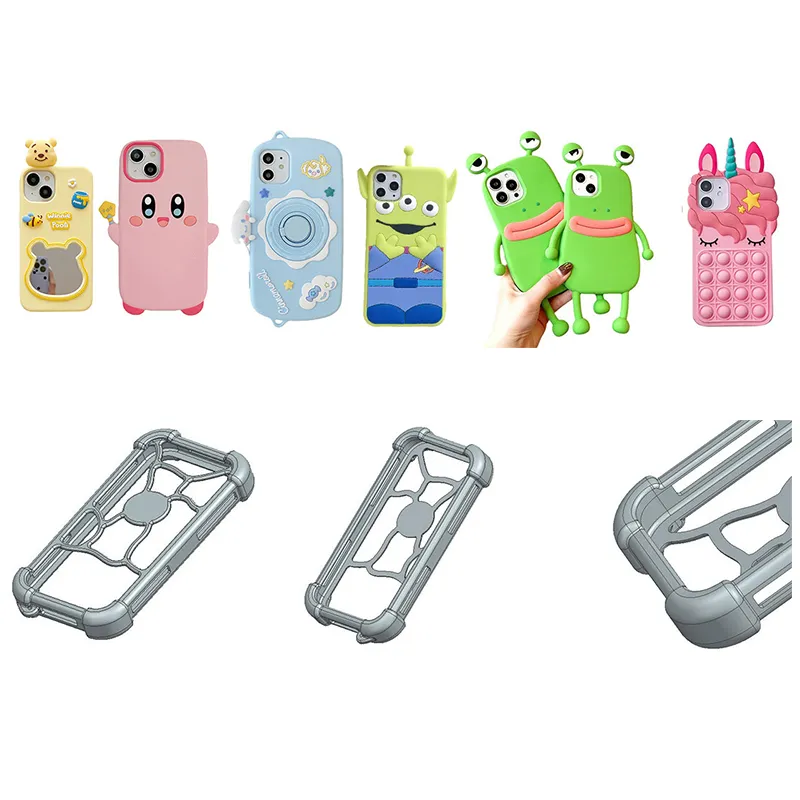
For standard consumer electronics parts such as remote control keypads, protective sleeves, damping pads, and cookware handle covers, the main targets are appearance, feel, and insertion life. Operating temperature is usually below 80 °C, and there is no strict requirement for long-term sealing, low volatility, or food-grade compliance. For these products, shipment after primary vulcanization is acceptable if all requirements are met. Secondary vulcanization can be added based on customer requirements or premium product positioning.
Still, some margin should be built in. If the customer has extra requirements for sealing life, odor, or long-term reliability—for example, premium electronics buttons that must maintain the same tactile feel for more than three years, or children’s products that require low odor—YueHouDZ recommends adding secondary vulcanization. The cost increase is limited. Based on industry experience, the total added cost for one process step is RMB 12 to 20 per batch, or about $1.78 to $2.96 per batch at an exchange rate of 1:6.75. The quality difference is easy for customers to notice. Treating an “optional” step as a standard step can support a premium positioning.
| Application | Operating Temperature | Volatility Requirement | Main Performance Target | Secondary Vulcanization Requirement |
|---|---|---|---|---|
| Consumer electronics keypads and protective sleeves | <80 °C | None | Appearance and feel | Optional |
| Damping pads and foot pads | <80 °C | None | Vibration damping and durability | Optional |
How to Select Secondary Vulcanization Parameters
Once the decision is made to post-cure, how should the parameters be set? The standard process is a forced-air circulating oven at 200 °C for 2 to 4 hours. Thin parts usually need 2 hours. Thick parts or parts for high-temperature service typically require 4 hours. In practice, process settings should be based on part thickness.
Thin parts (<5 mm): Use 200 °C × 2 hours directly.
Thick parts (>5 mm): Step heating is required to prevent blistering. If the part goes straight to 200 °C, the surface can seal first and trap inner-layer volatiles. Industry practice is staged heating: 150 °C for 1 hour, 180 °C for 1 hour, then 200 °C for 2 to 4 hours. Step heating gives internal volatiles enough time to diffuse out gradually.
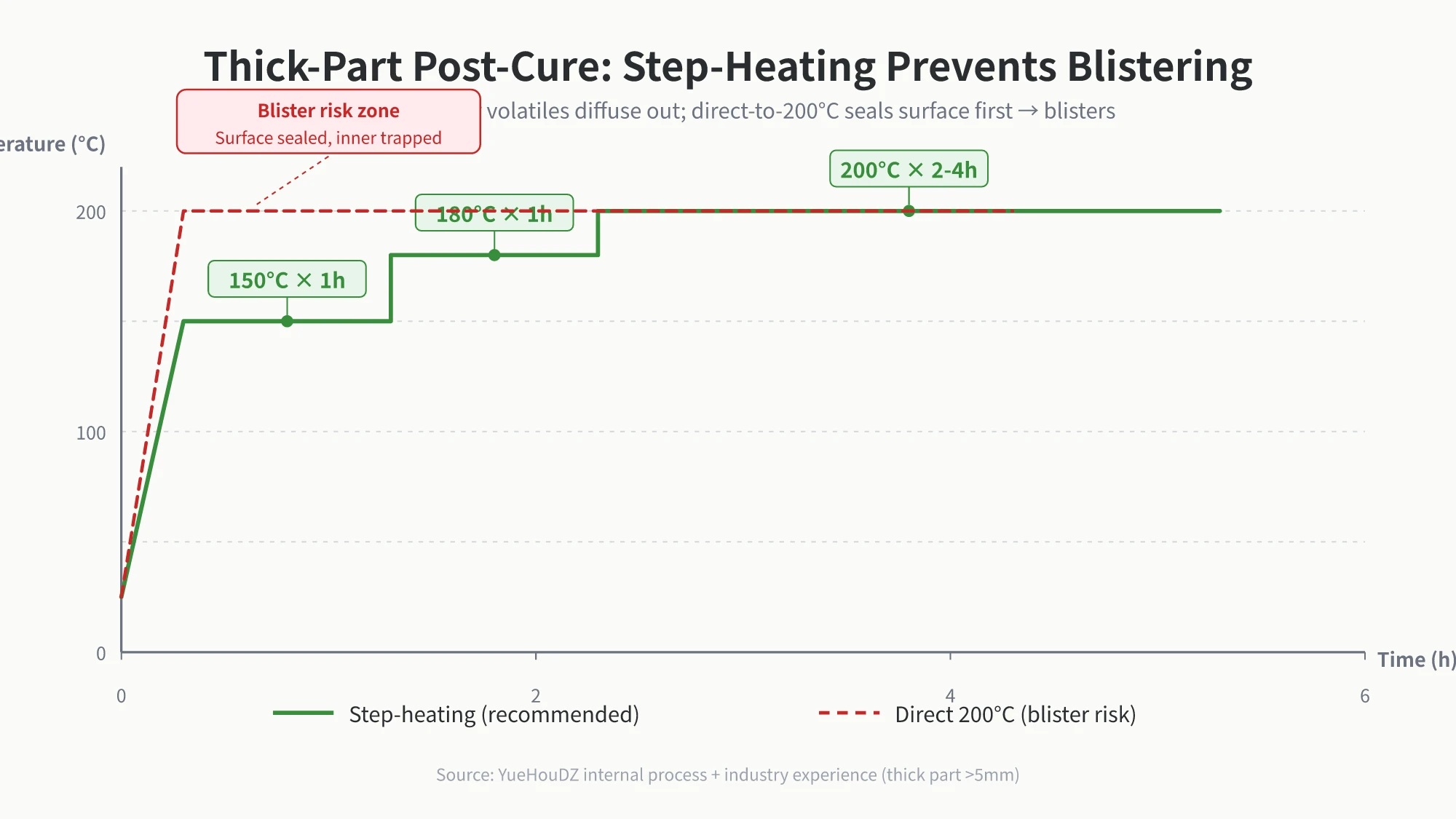
Airflow and ventilation: The oven must not run as a closed box. Air velocity should be at least 0.5 m/s, and air exchange should be more than 10 times per hour, based on industry practice. Forced convection removes volatiles in time. Green parts should be arranged in a single layer with at least 2 cm spacing. They must not be stacked. Stacking traps volatiles around the parts.
If Supplier A quotes 200 °C × 2h and Supplier B quotes 200 °C × 4h, what is the difference? Two hours is enough for thin parts. Thick parts or high-temperature service parts need 4 hours. The service condition drives that difference. It does not mean Supplier B is inflating the quote.
Primary vulcanization, done in the mold at 150 °C to 200 °C under pressure for 5 to 10 minutes, and secondary vulcanization, done in an oven at 200 °C for 2 to 4 hours, are sequential process steps. The first sets the shape. The second stabilizes performance. They are not alternative routes. Primary vulcanization cannot be skipped, and secondary vulcanization cannot replace it.
How to Verify Whether the Factory Actually Did It
If a quotation lists “secondary vulcanization,” that does not mean the production line actually performed it. How can incoming inspection verify it?
Ask for process parameter records. A well-run factory includes post-cure process records in the shipment report, including temperature, time, and batch data. YueHouDZ does this for high-temperature parts. If the supplier cannot provide the parameters, either the step was not done or it was not documented.
Check the compression set test report. Ask the supplier for an ASTM D395 test report at 22h@150 °C. Parts with only primary vulcanization usually show a compression set in the 20% to 25% range. After secondary vulcanization, values can drop to 9% to 12%. If the numbers do not match, there is reason to question the process.
Check odor and surface condition. A fully post-cured silicone part should not show a strong acetone odor when the cross-section is broken and smelled. The surface should not develop white powder bloom after 1 to 2 months of storage. These are the minimum signs that the process was done properly.
If the quote says the step can be omitted, the supplier is not simply helping reduce cost. It means the labor and process cost of one step has been removed. Compare that claim against the actual service conditions of the product before deciding whose advice to follow.
Frequently Asked Questions
What is the relationship between primary vulcanization and secondary vulcanization?
Primary vulcanization happens in the mold at 150 °C to 200 °C under pressure for 5 to 10 minutes. It sets the shape and establishes the basic crosslinked structure. Secondary vulcanization happens in the oven at 200 °C for 2 to 4 hours. It removes residual by-products, completes remaining crosslinking points, and drives off volatile fractions. The first forms the part. The second stabilizes performance. They are sequential steps, not two alternatives.
Does platinum-cured silicone also need secondary vulcanization?
Platinum-cured silicone, also called addition-cure silicone, does not generate by-products, so in principle it does not require secondary vulcanization. Still, high-spec medical, optical, and vacuum applications may use post-curing to stabilize material properties. This article focuses on peroxide-cured silicone using the DBPMH system, which produces more by-products, so secondary vulcanization is challenging to avoid. Note that platinum vs. peroxide is a choice of curing-agent system made during the primary vulcanization stage. Secondary vulcanization is a post-treatment after vulcanization. They are not on the same level and are not opposing process routes.
Is color change after secondary vulcanization normal?
Yes. For natural-color parts, the color may deepen by 0.5 to 1 shade after 200 °C × 4h, based on YueHouDZ internal color-difference control data. This is a normal result of high-temperature baking. For light-colored or transparent parts that are sensitive to appearance, this color shift must be considered in advance. Assemblies that include electronic components are not suitable for whole-part oven post-curing.
Can longer time or higher temperature deliver even better performance?
No. Performance does not keep improving without limit. Overdoing secondary vulcanization with excessive temperature or excessive time can make silicone parts brittle, discolored, and can even worsen compression set again. For peroxide-cured systems, 200 °C for 2 to 4 hours is the process sweet spot. Going beyond that range usually brings more downside than benefit.
Secondary vulcanization is not an extra value-added step. In high-temperature, low-volatility, and long-life sealing applications, it is a critical process step. The next time this step appears on a silicone part quotation, compare it against the product’s service conditions: temperature, sealing life, and volatility requirements. If any one of those three is strict, the step cannot be omitted. If none of them is strict, it can be discussed with the supplier as an optional step. If the requirement is still unclear, Contact Us at YueHouDZ and send the service conditions, including product type, operating temperature, and customer technical requirements, for a clear recommendation on whether post-curing is necessary.