When a silicone anti-slip footpad holds firmly on one floor but walks on another, it does not mean the pad is defective. A Walmart product page for washing machine silicone footpads showed 98 ratings: 73% gave 5 stars, while 6% gave 1 star (with reviews cited from 2025 to 2026). Some buyers blamed the old pads’ failure on stiff rubber, finding success after switching to softer material with mini suction cups. Yet other buyers saw the same suction-base pads slip on their floors. They were testing on different surfaces under different loads and contact conditions.
As a Silicone Product Manufacturer, YueHouDZ molds custom silicone footpads. When customers ask for “anti-slip” performance, our first question is not about durometer. We ask what surface the equipment actually sits on. Anti-slip performance is not a standalone property of the pad. It results from the interaction among the pad base, the floor surface, the equipment load, and working dynamics. Change the floor, and the underlying physics change too.
What Makes Anti-Slip Footpads Actually Work?
Elastomer friction relies on two main components: adhesive friction and hysteresis friction. Adhesive friction comes from true molecular contact where surfaces touch. Hysteresis friction comes from the energy lost as the soft silicone deforms around surface asperities under load. These two mechanisms work together. Their balance shifts whenever material, load, sliding speed, or surface finish changes.
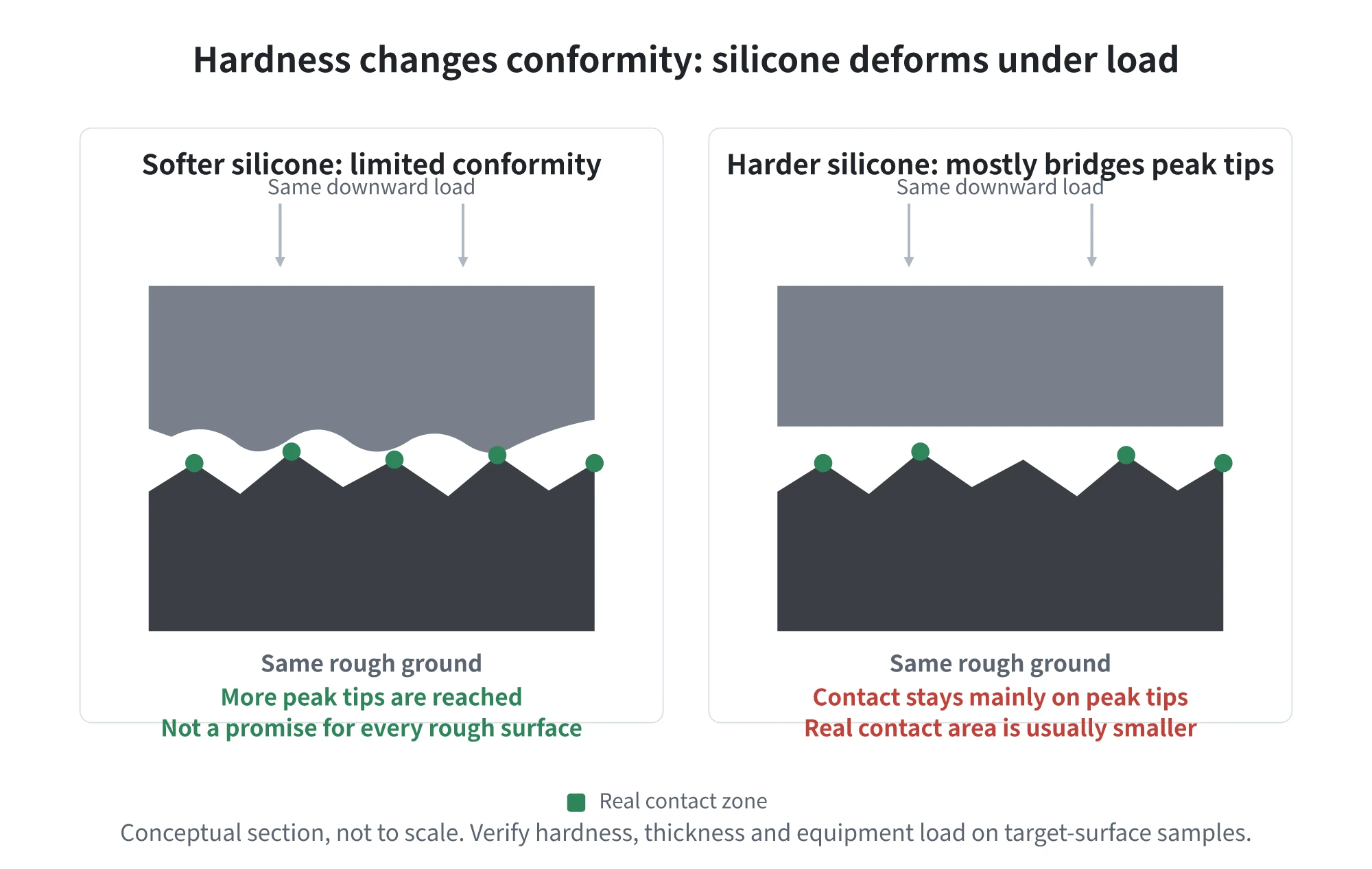
The key is “real contact area.” A pad might look flat to the naked eye, but microscopically, it only touches the peaks of surface roughness. On smooth surfaces with continuous contact, adhesion dominates. When rough peaks break up contact, hysteresis, material deformation, and bottom tread geometry play the major role.
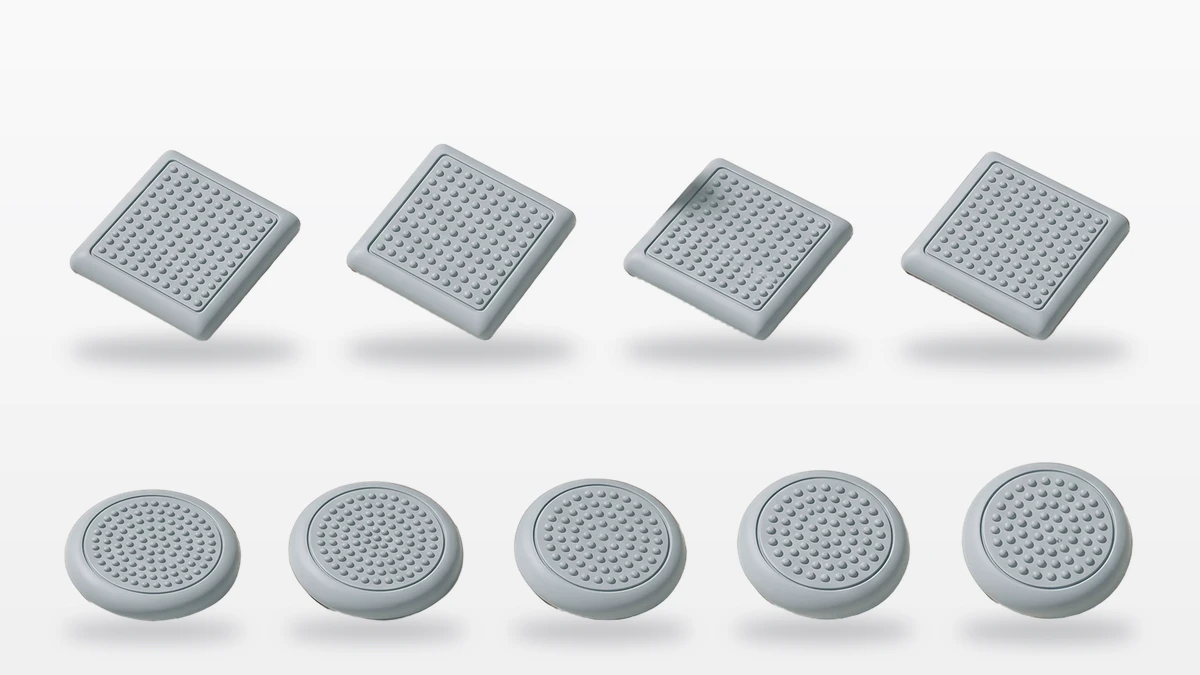
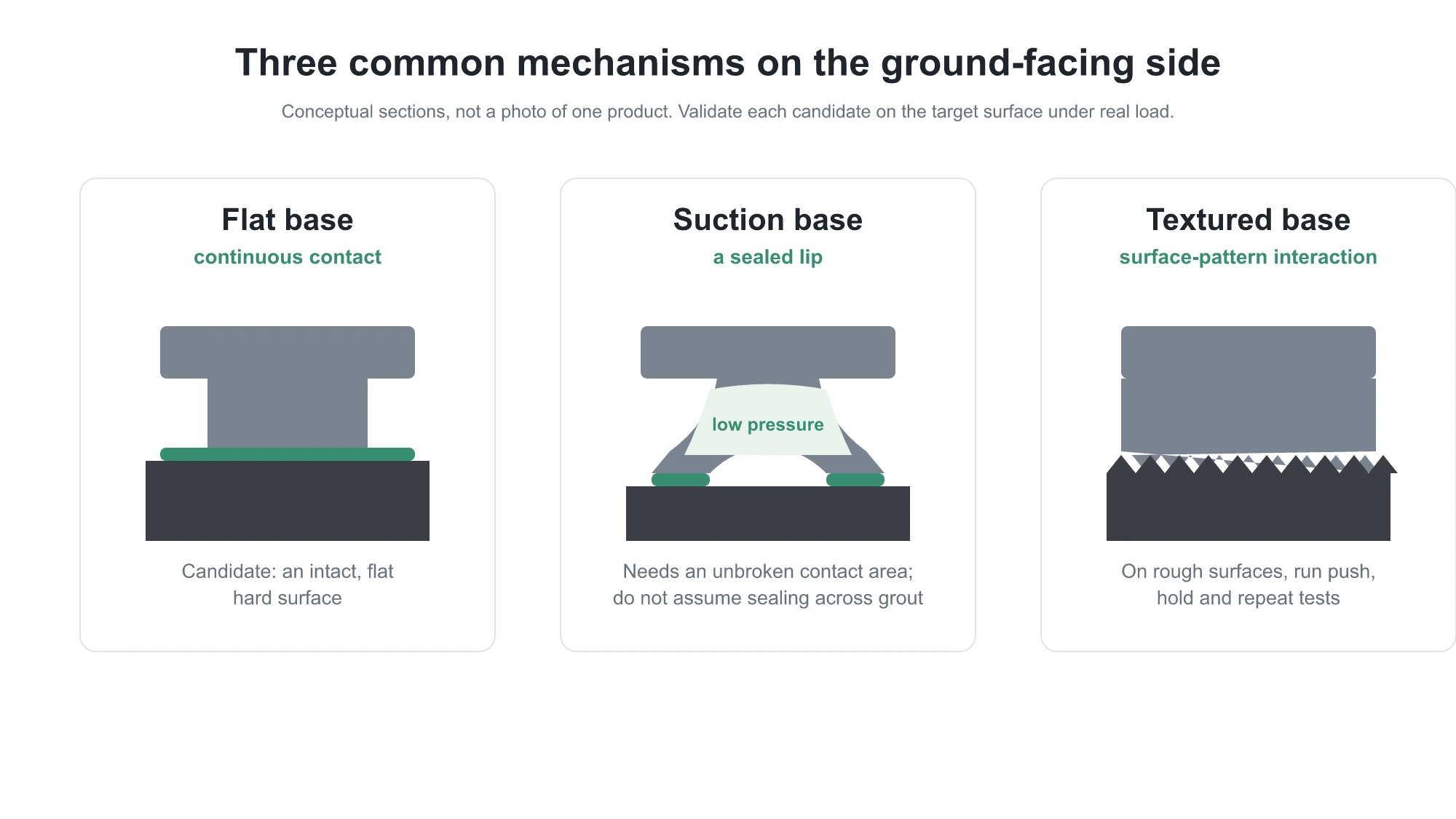
Engineers typically use three bottom profiles for floor contact: flat bases rely on continuous material contact; suction bases require a flexible lip to form an airtight seal; textured bases use ribs or patterns to mechanically interlock with surface roughness. These are not hierarchy levels where one is universally better. Each operates on different prerequisites. You cannot judge the bottom mechanism just by looking at decorative top studs.
Hardness affects how well the silicone conforms to the floor, but durometer alone tells only part of the story. For equipment pads, YueHouDZ typically starts prototyping within a 40–60 Shore A range. Final durometer selection requires testing with actual equipment weight, pad thickness, base geometry, and the target floor. Going too soft or too hard creates issues with sag, creep, or inadequate grip. No single durometer delivers maximum grip on every surface.
Tiles and Smooth Hard Surfaces: Focus on Full Contact Area
On flat, clean, and dry matching surfaces, the adhesive friction from true contact area becomes significant. Material compound, equipment load, and sliding speed still govern total grip. Polished tile, smooth stone, and glass suit flat or suction-base pads. However, you cannot assume a stable grip just because a surface looks glossy.
For suction pads, placement is critical. If a pad straddles a grout line, the lip cannot form a closed perimeter seal, and suction fails completely. When evaluating prototypes, place pads exactly where the equipment feet sit. Test both full tile surfaces and grout-crossing positions. Never rely solely on test results from seamless tile samples.
Tile names and gloss ratings are also insufficient. Ramp ratings from R9 to R13 indicate general slip resistance on sloped paths. Always check the tile manufacturer’s test report for intended application environments. A tile’s R-rating does not replace physical verification of the pad under actual machine load.
Wood Flooring: You Are Contacting the Surface Coating
Silicone pads on wood floors rarely touch bare timber. Instead, they contact polyurethane varnish, oil finishes, or wax layers. Industry technical data from flooring and pad manufacturers confirms that surface coatings heavily dictate friction. However, you cannot quantify grip without knowing the specific coating, cleanliness, and applied load.
When evaluating wood floors on-site, check whether the surface has fresh wax or special sealers and identify the exact placement zone. Retest on the target floor area. Never assume pad performance based on results from a different room or older floorboard, and avoid blaming silicone durometer before inspecting coating conditions.
Rough Surfaces: Do Not Rely on Suction Cup Seals
Rough substrates like broom-finish concrete, terrazzo, and textured ceramic alter two baseline conditions. Surface peaks and voids disrupt continuous contact for flat bases. Meanwhile, microscopic air gaps prevent suction cups from pulling a vacuum. The Hong Kong Consumer Council highlighted this in bathroom mat testing: never rely on suction cups for safety on rough or textured surfaces. This principle applies directly to industrial and appliance footpads.

Rough surfaces still allow reliable solutions, but you must switch to verifiable mechanisms. Consider Custom silicone manufacturing with mechanical tread patterns engineered for target surface roughness. Do not assume treads grip just because patterns look compatible. Never claim that interlocking geometry prevents all movement without testing. Validate grip using target floor samples and actual working loads through push, holding, and repetitive cycles to check displacement and rebound.
Why One Friction Coefficient Cannot Cover Three Floor Types
A coefficient of friction (COF) measures a specific “pad-plus-floor” pairing under controlled conditions. It is not an inherent material property. Load, velocity, temperature, surface contamination, material wear, and environmental moisture all alter COF values. Plastic film standards like ASTM D1894 or ISO 8295 cannot serve as floor friction ratings.
Floor testing standards also carry defined scopes. ASTM D2047 tests dry, polish-coated walkways; it is not applicable if surface texture, profile, or gaps prevent full contact with the James machine foot. ANSI A326.3 specifies dynamic friction testing for hard-surface floors, while ANSI A137.1 sets a wet DCOF threshold of 0.42 for ceramic tile. No single standard covers every footpad across all flooring substrates.
A friction reading measured on ceramic tile cannot serve as an acceptance threshold for textured concrete. At best, it provides a relative benchmark for that specific pairing. A drawing specification that merely states “COF ≥ X” without specifying mating substrate, dry/wet conditions, test load, and kinematics is impossible to inspect or enforce.
How to Set Verification Conditions by Floor Type
First, document the floor condition: smooth continuous surface, grouted/coated finish, or rough texture, along with dry or wet operating environments. Next, eliminate incompatible mechanisms. Do not specify suction cups across grout lines, and do not expect continuous flat adhesion on rough surfaces. Finally, prototype candidate base profiles and run push, static hold, and cycle tests under realistic equipment loads.

Verification logs do not need to be complex, but separate entries by floor type. Record surface condition, load, test protocol, and pass/fail criteria in a single row. If wet operation is possible, test and record dry and wet states separately.
| Parameter | Ceramic Tile Site | Wood Flooring Site | Rough Surface Site |
|---|---|---|---|
| Surface Condition | Actual glaze, grout crossing, dry/wet state | Coating or wax state, target placement area | Roughness profile, cleanliness, dry/wet state |
| Applied Load | Actual equipment operating load | Actual equipment operating load | Actual equipment operating load |
| Test Action | Push and static hold test | Push and static hold test | Push, static hold, and repetitive cycle test |
| Pass/Fail Criteria | Displacement or retention per project spec | Displacement or retention per project spec | Displacement, retention, and post-cycle rebound per project spec |
Always record the measured durometer of sample pads rather than nominal callouts. Durometer tolerances across batches or suppliers affect contact area and deflection. When benchmarking two pad designs, document durometer, base geometry, and test parameters together.
Conclusion
When floor types vary, you do not need to treat every project as completely unknown. Group surfaces by microscopic and mechanical characteristics. You can transfer performance baselines across similar smooth hard surfaces. However, whenever the contact mechanism shifts from continuous adhesion to peak contact, or suction seals turn into leak paths, build new prototypes.
When a silicone anti-slip footpad underperforms on a new floor, the pad rarely degrades overnight. Instead, its bottom profile no longer matches the contact conditions of the new substrate. At YueHouDZ, we adjust durometer, base tread patterns, and overall geometry to fit the application. The most reliable path to success is to evaluate actual floor conditions and operating loads, design Custom silicone mold tooling accordingly, and validate prototypes directly on the target surface—rather than searching for a mythical “one-size-fits-all” anti-slip padpad.