This article is based on YueHouDZ’s real project experience in customizing silicone food storage bags. As a manufacturer focused on silicone product design and production, we hope to help you turn a vague idea into a practical, manufacturable custom product through case studies and technical details.
1. Why Customize Your Own Brand of Silicone Food Storage Bags?
In real projects, many new brands start with standard silicone food storage bags for convenience, but quickly run into problems in use. For example, a baking brand found that the standard bags were not deep enough so that a 6-inch cake would be squeezed and deformed. A mother-and-baby client complained that generic bags had no internal dividers, so baby puree and fruit pieces stored together easily affected each other’s taste and smell.
Through customization, you can solve these pain points with an exclusive structure: not only can you match particular functional needs (such as deeper, three-dimensional structures for baking scenarios), you can also add brand elements (such as cartoon IP textures for mother-and-baby brands), and even open niche markets (such as lightweight foldable styles for outdoor brands).
2. What Are Silicone Food Storage Bags? Types and Application Scenarios
2.1 Definition
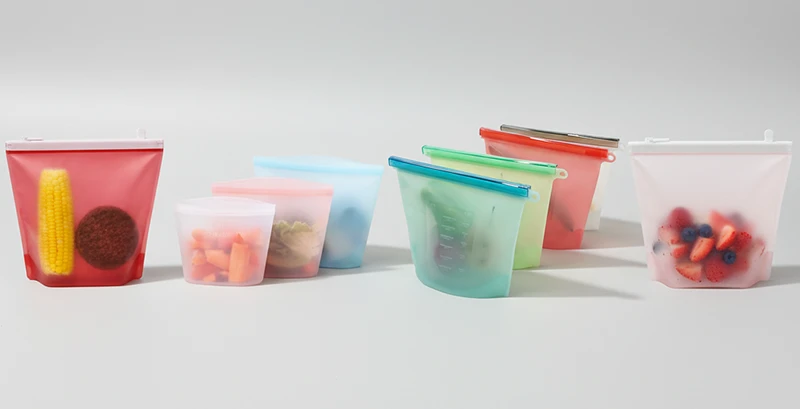
Silicone food storage bags are reusable food-packaging products made from food-grade silicone (BPA-free, phthalate-free). They can be seen as an eco-friendly alternative to traditional single-use plastic food bags. The core function is to achieve food storage and preservation through proper sealing design.
2.2 Common Forms: Typical Structures and Shapes
Common forms include:
- Zipper-seal bags – the mainstream choice for household kitchens;
- Self-sealing / press-seal bags – often used in outdoor and portable scenarios.
2.3 Where Are They Used, and When Should You Consider Customization?
Home kitchen scenarios: Customers often need bags that match special refrigerator drawer sizes to avoid stacked ingredients being crushed. They also require good sealing at low temperatures (down to freezing), resistance to oil, and easy cleaning, with internal corners that do not trap sauce or food residue.
Outdoor and camping scenarios: For outdoor brands, fold-down size is significant (for example, bags must fit into a small pouch). One-handed operation should be convenient, and for soups or liquids, the bag should pass an inverted leakage test.
Food retail packaging scenarios: For bakeries or dessert brands, bags must comply with food-contact regulations. The bag surface often needs printed brand logos and storage-temperature recommendations, and the structure must support different product shapes, such as cakes and cookies.
When you want packaging to communicate your sustainability message (for example, highlighting “reusable up to 1,000 times”), increase repeated brand exposure in the kitchen (distinctive brand color, recognizable logo), or serve as an entry point for a “kitchen storage solution” concept, you should seriously consider custom silicone food storage bags.
3. Key Information to Clarify Before Customizing
Before starting a customization project, clearly provide the following core information so the factory can translate your ideas into practical design parameters.
3.1 Six Essential Pieces of Information
- Usage environment: Temperature range (for example, freezing to boiling), types of foods (oily, acidic, high-salt), cleaning method (dishwasher, boiling, hand-wash), and frequency of use (household vs commercial).
- Structure and dimensions: Closure type (zipper, press-seal, roll-top), overall length, width, and height, applicable tolerances, stand-up bottom or flat bottom, and whether internal dividers or special structures (such as liquid channels or air valves) are needed.
- Material performance: Silicone thickness, hardness (Shore A), transparency or opacity, surface texture (matte, glossy, patterned), and whether odor level or aging resistance has special requirements.
- Quantity planning: Sample quantity, estimated first order quantity, and long-term replenishment or SKU plan.
- Timeline: Desired sample lead time and mass-production delivery time, and whether coordination with marketing launches or seasonal sales is required.
- Compliance and certifications: Target sales markets (domestic, EU, US, etc.) and food-contact standards to be met (such as FDA, LFGB), as well as required test items.
3.2 Simple Information Table You Can Send to a Factory
| Information Dimension | What You Should Tell the Factory |
|---|---|
| Usage environment | Temperature range, food types, cleaning method |
| Structure and dimensions | Closure type, key dimensions, whether you can provide drawings or samples |
| Quantity and lead time | Sample quantity, first order quantity, expected delivery time |
| Compliance and testing | Target certifications and required test items |
4. Customizable Dimensions: From Function to Brand
The core of customizing silicone food storage bags is to translate actual product needs into production parameters. Based on project experience, we can look at four dimensions: structure and dimensions; materials and performance; appearance and brand elements; and accessories and packaging.
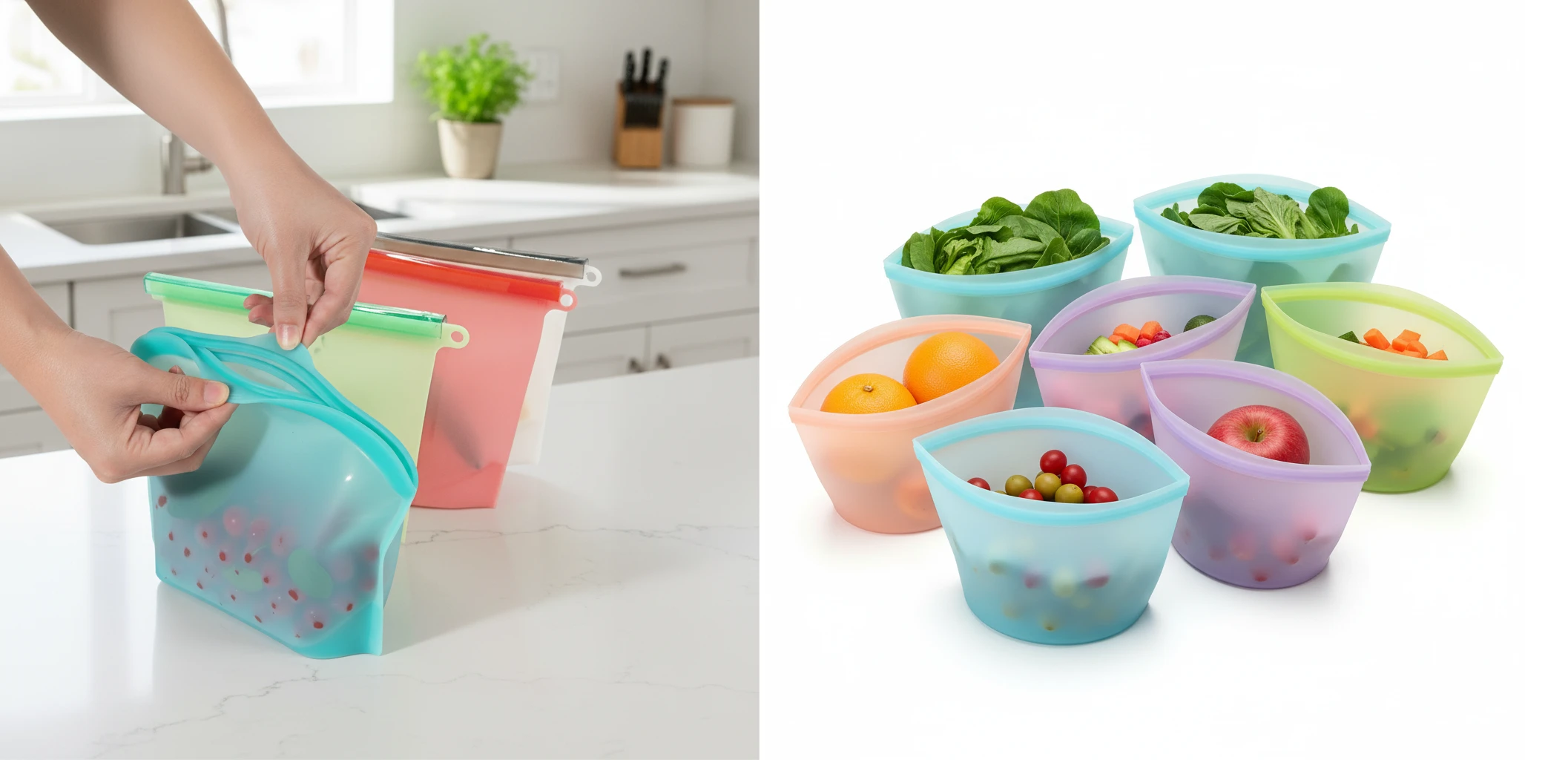
4.1 Structure and Dimensions: Define Product Form Based on Usage Scenarios
Closure type is the key factor affecting sealing performance and cost. Common options:
- Zipper-seal: Best sealing performance, suitable for liquids (soups, sauces), but mold cost is about 15–20% higher than other types. In catering projects, we have found that double-track zippers clearly outperform single-track designs, but the exact improvement should be verified by testing.
- Press-stud / snap closure: Very convenient to open and close, suitable for daily household use (vegetables, leftovers). Typical opening and closing life is about 1,500–2,500 cycles (reinforced designs can reach around 3,000 cycles). Outdoor customers often request larger snap areas to make the operation easier when wearing gloves.
- Roll-top closure: Sealing can be manually adjusted by rolling and squeezing out the air. It is well-suited for dry goods (grains, nuts) and is the least expensive option. Note that roll length should be at least 5 cm; otherwise, it is prone to loosening.
Volume specification should match typical usage scenarios. Standard sizes cover about 500 ml (snacks, condiments), 1 L (meal prep, semi-finished dishes), and 2 L (large portions, meat). You can also customize special capacities (for example, 300 ml for baby food), but detailed dimension drawings are required.
Folding design determines storage efficiency and user experience:
- Stand-up design: The bottom usually needs a thicker wall of about 0.8–1.2 mm for better load-bearing (suitable for liquids and heavy contents), but it takes up more storage space.
- Foldable design: Uses thin silicone of about 0.3–0.5 mm. Compared with stand-up versions, storage space can be reduced by up to 80%, making it very suitable for travel and small kitchens.
5. Materials and Performance: Foundation from Safety to Durability
The choice of silicone material directly affects product safety, hand feel, and cost. Focus on silicone type, curing system, and hardness.
Silicone type:
- Fumed silicone: Very high purity (typically above 99.5%), high transparency, good aging resistance. Under normal use, service life can reach about 2–4 years, and under ideal storage conditions, about 3–5 years. The cost is about 30–40% higher than that of precipitated silicone, making it suitable for mid–to high-end markets.
- Precipitated silicone: More cost-effective; elasticity is slightly lower (typical elongation at break around 300–400%, while fumed silicone can reach around 500–600%). It is suitable for mainstream or value-oriented products.
Curing system:
- Platinum-cured silicone: Little odor and no problematic by-products, easier to meet FDA or LFGB food-contact testing. It is the first choice for direct food-contact products.
- Peroxide-cured silicone: Lower cost (about 15% cheaper), but may require secondary curing to reduce odor and residual volatiles. More suitable for scenarios with high price sensitivity and lower odor requirements.
Hardness (Shore A):
- 30–40 Shore A: Very soft and easy to deform, suitable for wrapping irregular foods (cheese, fruit pieces).
- 50–60 Shore A: Balanced hardness and elasticity, suitable for most household applications.
- 70–80 Shore A: Higher stiffness and stronger tear resistance, suitable for high-frequency use in restaurants and take-out businesses.
6. Appearance and Brand Elements: Make the Product an Extension of Your Brand
Appearance customization is not only about aesthetics, but also about conveying brand positioning. Plan from color, surface texture, and logo process.
Colors:
- Basic color choices: transparent, milky white, and solid colors that match food-contact standards.
- Deeper or gradient colors: need attention to pigment migration and testing; pigment loading should be controlled within a reasonable range so that elasticity and safety are not affected.
Surface textures:
- Matte / frosted: Better anti-slip performance, suitable for wet-hand operation in kitchens. Usually formed via surface treatment on the mold; no extra unit cost for mass production.
- Glossy: Easy to clean but more prone to showing fingerprints and streaks.
- Grid or pattern textures: Can enhance tear resistance and visual differentiation.
Logo processes:
- Silk-screen printing: Low cost and suitable for simple graphics, but washing resistance is limited. After a certain number of dishwasher cycles, fading or peeling may occur.
- Laser engraving: No ink involved, very durable, suitable for fine-line logos and text. However, color is usually limited (for example, white or gray marks on the silicone.
- In-mold logo or embossed logo: Formed directly in the mold. The logo is integrated with the silicone and has high durability, suitable for long-term use.
7. Accessories and Packaging: Complete the Experience
Functional accessories can solve very specific pain points:
- Detachable hooks: Typically PP material, adding about $0.07 per piece to the cost. They make it convenient to hang the bag for drying in kitchens or bathrooms.
- Writable labels: Silicone areas integrated with the bag that allow users to mark dates with a marker pen, helping to reduce the risk of expired food.
- Storage boxes: PET transparent boxes are suitable for selling sets (such as 3-piece kits), but they increase packaging cost by about 15–20%.
Packaging strategies should match your product positioning:
- Basic tier: OPP bag with header card, costing about $0.04–$0.07 per set, suitable for value markets or promotional giveaways.
- Mid-tier: Full-color printed carton, costing about $0.14–$0.29 per set, suitable for mainstream e-commerce products.
- Premium tier: Kraft-paper gift box with foam insert, costing about $0.43–$0.71 per set, suitable for gift channels or premium mother-and-baby lines.
8. Structural Design Guidelines for Silicone Food Storage Bags
Good structural design directly affects sealing performance, durability, and production feasibility. Below are typical reference values that can be adjusted based on real testing and product positioning.
8.1 Sealing Structure Design
| Parameter | Typical Value | Description |
|---|---|---|
| Lip seal height | 1.2–2.0 mm | With 30–50% compression, suitable for ambient to moderately high-temperature applications |
| Sealing contact area | ≥ 2 mm² | Ensures sufficient basic sealing area |
| Height difference of mating ribs and grooves | 0.5–0.8 mm | Works with medium hardness silicone to provide a reliable seal |
| Roll-top extrusion diameter | 8–12 mm | At least 1.5 turns of rolling for stable sealing; relies on elastic recovery |
8.2 Wall Thickness Control
| Parameter | Typical Value | Description |
|---|---|---|
| Main wall thickness | 0.8–1.5 mm | Tolerance typically ±0.1 mm to balance flexibility and tear resistance |
| Corner thickness increase | +0.2–0.3 mm | Helps avoid thinning in corners caused by flow issues |
8.3 Opening Design
| Parameter | Typical Value | Description |
|---|---|---|
| Zipper tooth height | 1.0–1.2 mm | Tooth pitch around 2.5–3.0 mm; opening/closing force typically 3–5 N |
| Number of snaps | About 1 per 10 cm | Raised part height around 2.5 mm; recess depth around 2.8 mm |
| Roll-top width | ≥ 20 mm | Used with a silicone buckle; suitable for capacities greater than about 2 L |
8.4 Cleaning and Safety-Oriented Details
| Parameter | Typical Value | Description |
|---|---|---|
| Inner corner radius | R ≥ 0.5 mm | Prevents sharp corners that trap food residues and detergents |
| Depth of seal grooves | ≤ 0.8 mm | Bottom slope helps drainage and cleaning |
| Surface roughness | Ra ≤ 0.8 μm | Smoother surfaces reduce dirt accumulation |
| Hanging hole design | Depth ≤ 3 mm | Blind holes should avoid water pooling and be easy to dry |
9. From First Contact to Final Delivery: Step-by-Step Checklist
The typical customization process for silicone food storage bags includes requirement communication, design, sampling, mold fabrication, mass production, inspection, and shipment. Good control of each step can greatly reduce risk.
- Initial inquiry: Provide basic usage scenarios, desired structure, approximate dimensions, and expected quantity. Attaching reference photos or samples helps avoid misunderstandings.
- Quotation and solution confirmation: Confirm material type, process, mold cost, unit price, and payment terms. Make sure it is clearly stated whether the mold fee includes minor modifications.
- Mold drawing approval: The factory provides 2D or 3D mold drawings. Carefully review sealing structures, wall thickness, parting lines, and vent locations, and confirm in writing.
- Sample testing and approval: After samples are made, test sealing performance, odor, dimensions, and compatibility with target containers or foods. Keep one signed reference sample.
- Production contract: Confirm mold ownership, quality standards, and conditions for claims. For example, specify what happens if the material grade differs from that agreed.
- Production follow-up: Check key process parameters (such as molding temperature and curing time) and request periodic progress updates.
- Mass-production inspection: Use a suitable sampling plan (for example, AQL) to check appearance, dimensions, sealing, and odor. Doing a 24-hour inverted water test on random samples is recommended.
- Shipment confirmation: Confirm packaging details, shipping marks, and documents. For export, make sure customs documents match the actual goods to avoid delays.
10. MOQ, Lead Time, and Cost Structure
10.1 Typical MOQ
- Using existing molds (logo or color customization only): About 500–1,000 pieces, with no extra mold fee. Suitable for small brands testing the market or for gift projects.
- Light mold modification: Adjusting closures or adding small structural features usually requires a higher MOQ (for example, 2,000–3,000 pieces) and a moderate mold fee.
- Fully custom molds: New sizes and structures often require 3,000–5,000 pieces or more to spread mold costs reasonably. Complex multi-compartment designs are usually more economical at 5,000 pieces or above.
10.2 Typical Lead Time
- Existing mold customization: Sample lead time about 7–10 days; mass-production lead time about 15–20 days; overall about 1 month.
- Light mold modification: Mold fabrication about 15–20 days, sample 5–7 days, mass production 20–30 days.
- Expedited options: Mold lead time can sometimes be shortened by about 10 days for an additional $285–$430, and samples can sometimes be expedited by about 2 days for an additional $70–$115. Expediting may affect process stability and must be evaluated carefully.
10.3 Cost Breakdown Example (1 L Zipper-Seal Bag)
Example: 1 L zipper-seal silicone food storage bag, for reference only.
- Mold fee: About $285 for light mold modification (exact value depends on final structure).
- Material cost: About 45% of total cost. Food-grade silicone material cost is roughly $0.11–$0.21 per piece, depending on size and thickness.
- Processing cost: About 22% (including molding and trimming). The percentage decreases as the order quantity increases.
10.4 Strategy Suggestions
- To lower MOQ: Start with existing molds plus custom colors and logos to test the market, then upgrade to structural modification later.
- To protect lead time: Confirm sealing structure and material specifications as early as possible, and lock in material supply.
- To control cost: For large-volume orders (for example, 5,000 pieces and above), use multi-cavity molds to reduce mold cost per unit significantly.
11. Common Pitfalls and How to Avoid Them
Pitfall 1: Fake Material Certifications
Risk: The supplier claims to use food-grade silicone and shows certifications, but actually uses industrial or recycled material. This may cause products to fail testing and even be detained at customs.
How to avoid it: Ask for original scanned certificates and verify them through official channels where possible. Sign a written agreement on material authenticity and specify penalties for non-compliance.
Pitfall 2: Poor Sealing Performance
Risk: Samples use double 3 mm sealing ribs, but mass production has changed to a single 2 mm rib without notice, resulting in leakage during simple inverted water tests and causing many complaints.
How to avoid it: Clearly specify the number, width, and height of sealing ribs and silicone hardness in the contract. Require a 24-hour inverted water test video or a third-party test report before mass production.
Pitfall 3: Dimensional Deviations
Risk: Drawings do not indicate tolerances. The supplier applies their own tolerance (for example, minus 2 cm). The finished bag is 2 cm narrower than requested and cannot fit the intended container.
How to avoid it: Mark tolerances for critical dimensions (length, width, thickness) on drawings (for example, ±0.5 mm). Confirm 3D mold drawings before machining and measure samples carefully before approving.
Pitfall 4: Strong Odor
Risk: Cheap curing agents or release agents and insufficient curing time cause a noticeable odor when opening the package, possibly failing odor or migration tests.
How to avoid it: Ask for odor test reports and perform your own sensory checks after ventilation. Pay attention to curing temperature and time during production.
Pitfall 5: Big Differences Between Samples and Mass-Production Goods
Risk: Sample wall thickness is 0.3 mm with good tensile strength, but in mass production, it is reduced to 0.2 mm, making the bag easy to tear. Customers complain that it “breaks with a single pull.”
How to avoid it: Sign a quality agreement detailing minimum thickness and mechanical performance requirements. Keep retained samples from each batch and use them as acceptance standards.
Pitfall 6: Logo Printing Peeling Off
Risk: Low-quality inks and incomplete curing result in logos quickly peeling off after dishwasher use.
How to avoid it: Use food-contact silicone inks or switch to laser engraving or in-mold logos for key SKUs. Request adhesion test data and perform simple cross-cut tests on-site.
12. What to Prepare Before Talking to a Factory
12.1 Technical Data: Explain Dimensions and Structures Clearly
- Design files: 2D engineering drawings and/or 3D models (for example, STEP or IGS format) or physical samples.
- Key dimensions: Width of the opening, height, maximum thickness, and tolerances for critical dimensions.
- Surface finish: Matte, glossy, or special coatings, with a description of the desired feel.
- Fallback option: If you do not have drawings, provide reference samples and clearly describe changes (size, hardness, structure).
12.2 Application and Operating Conditions
- Target standards: Food-contact regulations for the destination market (such as relevant FDA or LFGB standards).
- Operating conditions: Temperature range, contact media (water, oil, acidic foods), and whether microwave or oven use is required.
- Usage frequency: Expected number of reuses and daily/weekly usage pattern.
- Testing requirements: Migration tests, heavy metal tests, odor tests, and any antibacterial performance requirements.
12.3 Commercial and Cooperation Information
- Quantity planning: Estimated MOQ for each SKU and step quantities for volume pricing.
- Lead-time expectations: Required lead time for molds and mass production.
- Budget range: Target unit price range (for example, $0.43–$0.71 per piece) and acceptable price range for small-batch orders.
- Cooperation details: Whether an NDA is needed, how packaging artwork will be provided, and shipping preferences.
12.4 Information Template (Ready to Copy and Fill In)
| Information Dimension | What to Explain | Example / Notes |
|---|---|---|
| Drawings / samples | Whether you can provide drawings or samples | Provide 2D/3D drawings and old samples with marked changes |
| Key dimensions and tolerances | Critical dimensions and tolerances | Opening width tolerance ±0.5 mm, thickness tolerance ±0.2 mm |
| Application and conditions | Temperature, media, and usage frequency | Freezer to boiling water, contact with oils, reuse at least 100 cycles |
| Certification and testing | Required certifications and test items | FDA or LFGB food-contact testing, odor tests, migration tests |
| Quantity and lead time | MOQ and delivery time | MOQ 5,000 pieces, 20 days for molds, 35 days for production |
| Budget and payment | Target unit price and payment terms | Target price $0.43–$0.71 per piece, 30% advance payment |
| Packaging and confidentiality | Packaging design and confidentiality requirements | Color box with “food contact” icon; NDA signed before sharing drawings |
13. FAQ on Custom Silicone Food Storage Bags
Q1: Can I Customize Silicone Food Storage Bags If I Have No Design Experience?
A: Yes. Most factories offer free basic design services (such as adapting existing templates or converting samples into drawings). More complex structural design usually costs about $70–$285. We can help turn reference samples into manufacturable engineering drawings.
Q2: How Much Does the Mold Cost? Can It Be Shared or Rebated?
A: For basic designs, mold fees are typically around $430–$860. For designs with snaps, sliders, or more complex structures, mold fees are often around $1,145–$2,145. In many cases, you can negotiate a partial refund of mold fees after cumulative orders reach a certain quantity (for example, 10,000 pieces), or agree to share molds with other partners with clear intellectual property terms.
Q3: How Do I Judge Whether a Silicone Food Bag Factory Is Reliable?
A: Check whether the factory has valid FDA, LFGB, or related domestic certifications, whether it has solid silicone compression molding presses or liquid silicone injection molding machines (LSR injection), and whether it has raw material, in-process, and finished-goods inspection systems. Response speed (for example, sending a basic proposal within 24 hours and samples within about 10 days) is also an important indicatoVisitsit the factory or, at a minimum, request video tours of the production and quality-control processes.
Q4: How Long Does It Take from Idea to Finished Silicone Food Storage Bags?
A: The complete cycle typically takes about 40–60 days: design 3–5 days, mold fabrication 10–15 days, sampling 7–10 days, mass production 20–30 days, plus shipping time.