
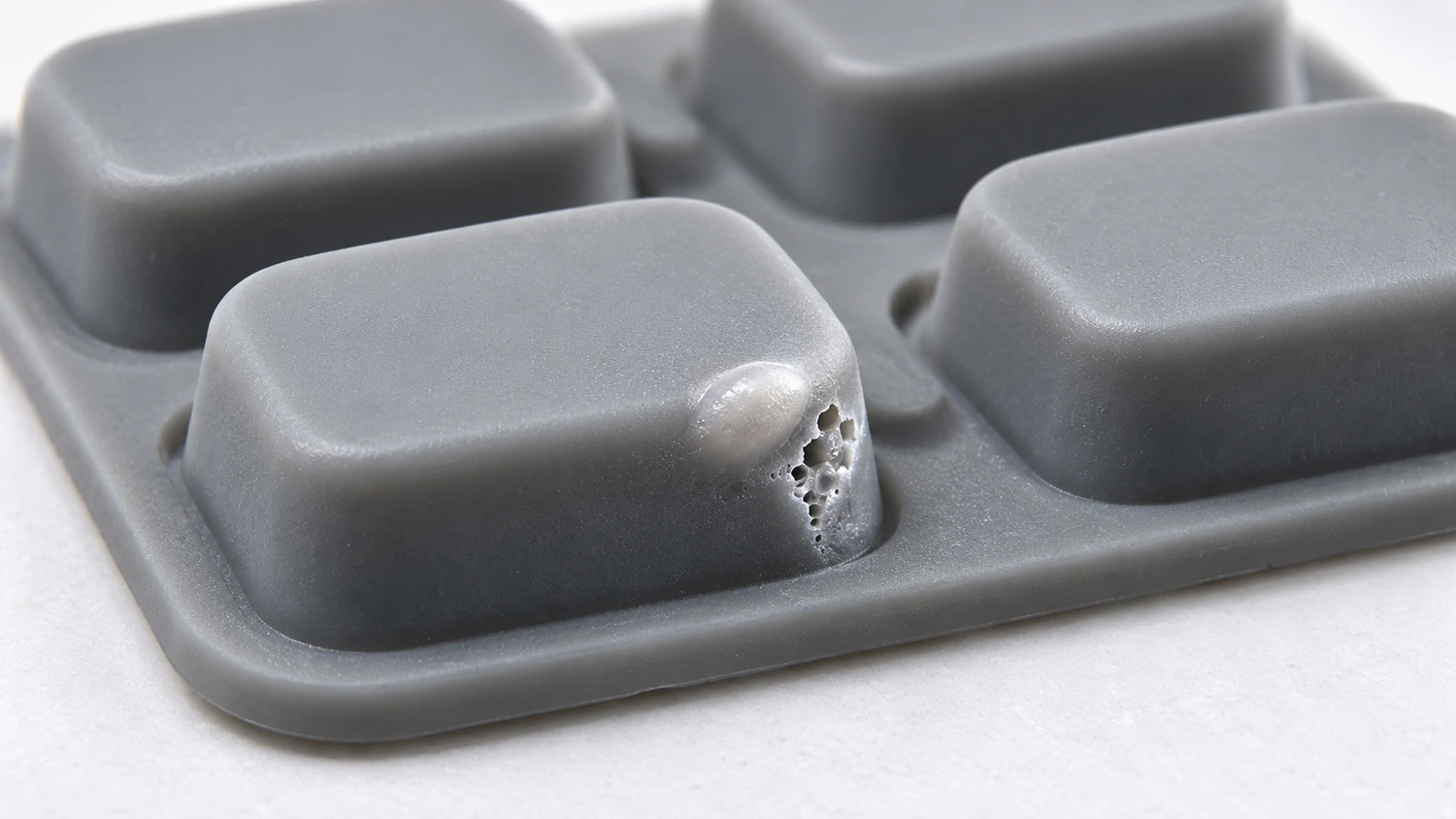
Illustrative reconstruction of a bubble defect in a silicone keypad.
When evaluating silicone samples, a missing section along an edge, a raised bubble on the surface, or a localized brown patch is a quality issue worth investigating. Understanding how these defects form helps make a request for “good quality” more specific: which defects are unacceptable, and which areas need particular attention during inspection?
YueHouDZ primarily uses compression molding for solid silicone, also known as high-consistency rubber (HCR). To understand defects in these products, start with how the compound fills the mold, how air escapes, and how curing fixes the shape.
How does a preform become a molded part?
In direct compression molding of solid silicone, a weighed quantity of compound is first shaped into a preform and placed in the open mold cavity. The cavity is the space that determines the product’s shape. As the upper mold closes, the compound spreads outward and gradually fills the cavity. The air previously occupying that space needs to escape from the mold.
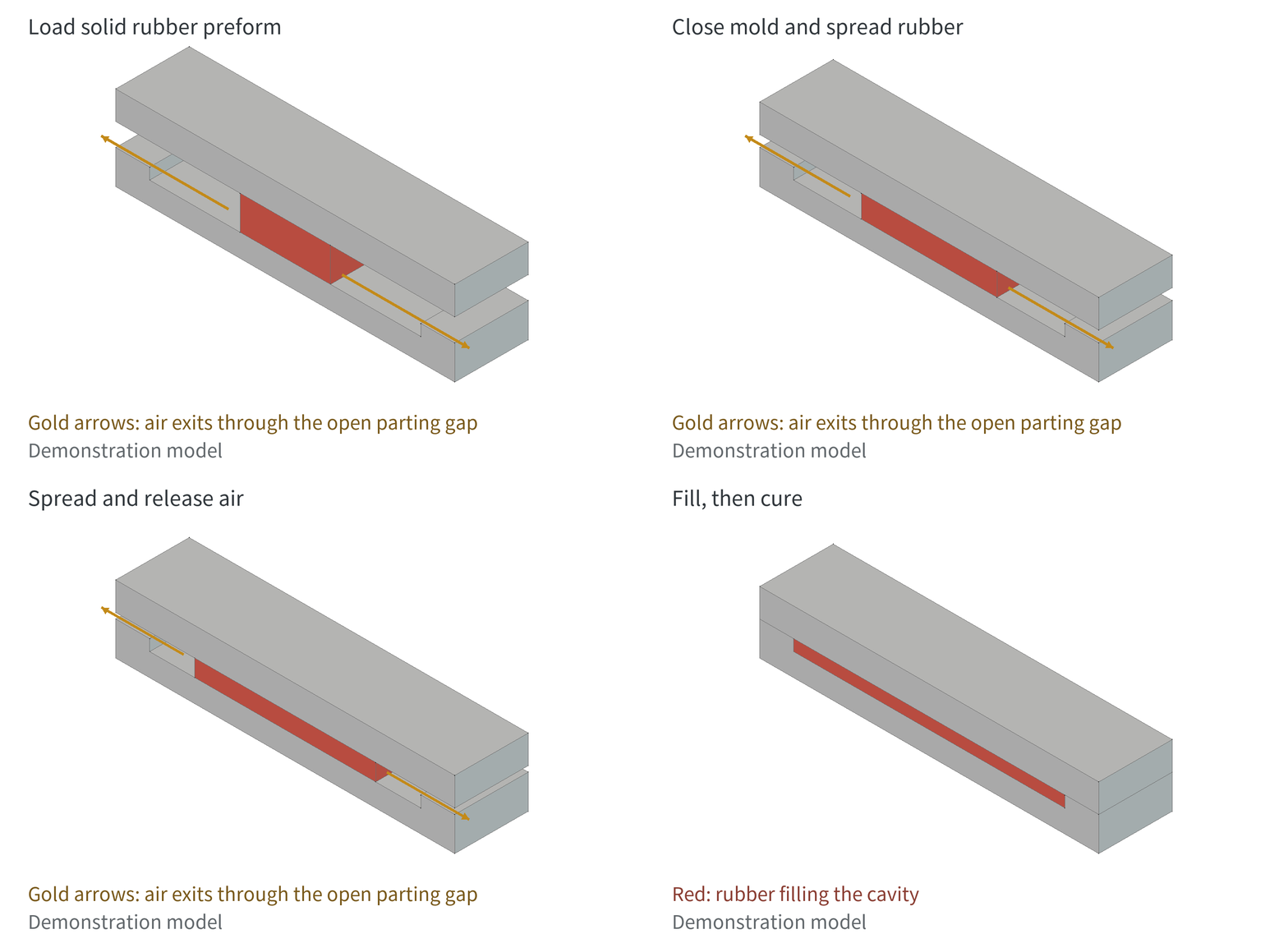
The compound also cures inside the mold. Crosslinking creates an elastic network that fixes the shape formed during filling. As curing progresses, the compound gradually loses its ability to flow. Filling and air release must therefore be completed while the compound can still flow. If an area remains unfilled but the nearby compound has already started curing prematurely, further pressure will struggle to push it into the remaining space.
Underfill: too little compound, or incomplete flow?
Underfill means that the product’s intended outline has not formed completely. Examples include a missing section of an edge, an incomplete thin lip, or a small feature that has failed to form. This can happen because there is too little compound or because the compound cannot reach those areas in time.
When there is too little compound, the available material runs out before the cavity is full. In a mold with multiple cavities, each cavity needs enough material. Having enough compound for the mold as a whole does not mean every individual cavity has enough.
When material is available but fails to fill an area, the flow path and the timing of curing matter. The preform’s shape and placement determine how far the compound must travel. Restricted passages can delay filling in particular areas. If the compound loses its ability to flow first, corners or fine details may remain incomplete.
Dow’s processing guide for solid silicone describes curing before flow is complete as scorch and notes that it can cause distortion or incomplete molding. A long delay between loading the compound and closing the mold can allow it to cure prematurely. In a mold with multiple cavities, the first preform loaded waits longer in the mold than the last and is more likely to start curing early. Loading time can therefore affect filling.
Adding more compound will not always resolve underfill. Once the material has cured prematurely, it struggles to flow into a gap even if more compound is available nearby.
Air bubbles: where has the air become trapped?
Air may already be in the cavity or enclosed within the compound itself. As the compound spreads, air in the cavity needs to escape through gaps or vents that remain open to the outside. If the advancing compound seals an exit first, the remaining air can become trapped in a localized area.
The animation below shows a different situation: air is enclosed within the compound from the start. Under compression, the air pocket becomes flatter but remains surrounded by silicone. A change in the pocket’s shape does not mean that the air has escaped.
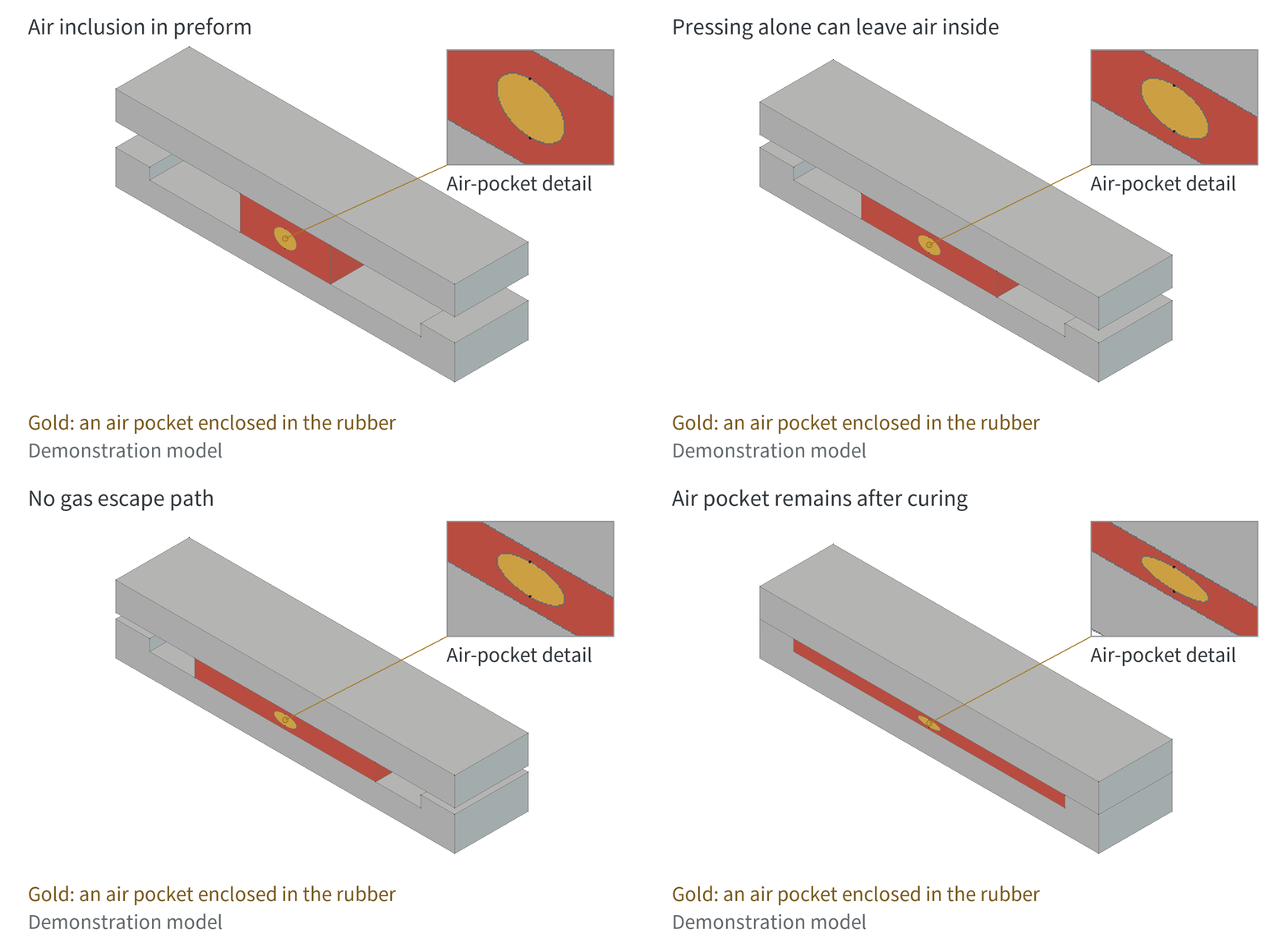
If the air does not escape in time and the surrounding compound cures, an internal void can remain. It may also appear as a raised bubble on the surface. What matters is whether the air can actually reach the outside of the mold. A groove beside the cavity does not necessarily connect a trapped pocket to the outside. Overflow grooves that collect excess compound and tear-trim grooves that help with trimming cannot automatically serve as vents.
A raised bubble, a soft area, and a void are different conditions. Dow’s guide notes that, in some of the curing systems it discusses, trapped air can also interfere with local curing and leave soft, discolored areas. This depends on the curing agent; the same reaction cannot be assumed for all solid silicone compounds. A surface bubble alone does not reveal whether the underlying defect is a void or an undercured soft area.
Burn marks: a brown patch does not confirm burning
Visible brown patches or dark marks are often called “burn marks.” That description is different from the scorch discussed earlier. Scorch means premature curing, which primarily interferes with filling. It does not require the product to turn black or brown.
Surface discoloration can also come from contamination. Dow’s guide lists release agent buildup in the mold and dust or dirt on preforms among the possible causes. WACKER’s compression molding guide also warns that excessive release agent can form deposits on cavity walls. Assuming that every discolored patch means the compound has burned can overlook mold deposits or contamination on the preform.
These three types of defect can also be related. Premature curing can cause underfill, while trapped air in some curing systems can cause both soft areas and discoloration. However, missing sections, bubbles, and discolored patches are visible results; each does not point to one unique root cause. Understanding these relationships helps you raise specific quality concerns instead of describing every defect as “burnt.”
Make unacceptable defects clear before sampling
Understanding underfill, bubbles, and burn marks helps you explain your quality expectations when developing a product. When speaking with a factory, make clear in advance that you will check for these defects, which visible surfaces and sealing areas must be free of them, and what makes a sample acceptable. Being specific also shows the factory that you understand the product’s quality risks and will inspect the finished parts carefully.
If you only ask for “good quality,” you and the factory may interpret the acceptance criteria differently. Explaining unacceptable defects before sampling, and agreeing on sample and inspection requirements, helps the factory give those concerns attention early. It can also reduce disputes after production over requirements the factory says were never mentioned.