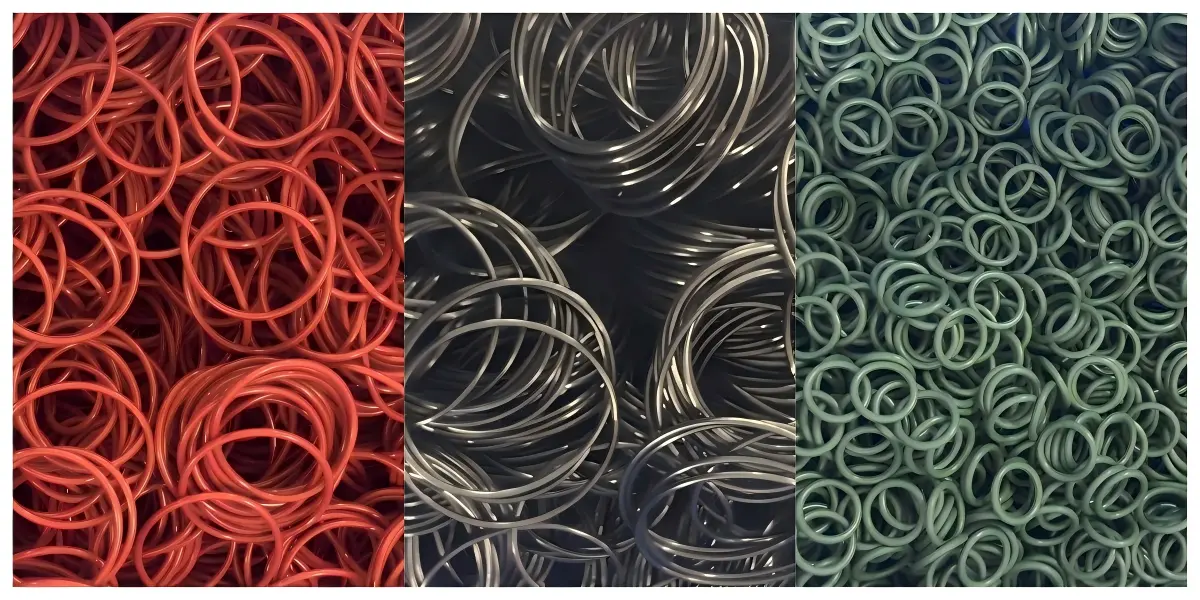
A customer returns a batch of outdoor sealing parts that hardened and cracked in less than a year, causing the IP67 rating to fail. The drawing specifies only “Silicone O-Ring, 60 Shore A, IP67,” with no weather-resistance requirements. The next step is to trace the formulation used for the parts. You need to determine whether the supplier omitted the weather-resistant additives, whether curing was inadequate, or whether the drawing failed to specify the requirement.
Silicone naturally offers better UV resistance than general-purpose rubber, so why do outdoor parts still harden? The answer doesn’t lie in the base polymer designation. With the same VMQ base polymer, adding UVA and HALS UV stabilizers can extend outdoor service life by three to five times. Four conditions determine whether an application needs standard VMQ, weather-resistant MVQ, or FVMQ: exposure to oils and solvents, UV intensity, required service life, and operating temperature. These factors also help buyers identify several common but misleading supplier claims.
The Actual Mechanism Behind Outdoor Hardening
Many people assume that silicone hardens because UV radiation breaks the main polymer chain. The actual cause is photo-oxidation.
UV photons don’t have enough energy to break Si-O bonds. Their bond energy is 452 kJ/mol, about 30% higher than the 346 kJ/mol bond energy of the C-C bonds found in general-purpose rubber. However, UV energy can still trigger reactions in the side groups.
UV exposure initiates photo-oxidation. Methyl groups detach from the side chains, and the surface crosslink density rises. This creates a silica-rich brittle layer, which is a hard, brittle surface caused by excessive crosslinking. The part then loses elongation and resilience. Hardened parts often show brittleness, chalking, and poor recovery rather than a minor increase in hardness.
Changing the base polymer won’t solve the problem. The formulation must include the correct additives. Standard silicone without a weather-resistant additive package may begin to harden after one to two years outdoors. A formulation combining UVA and HALS can last three to five years. This difference comes from the additive package, not the base polymer.
VMQ and MVQ refer to the Same Material
If a supplier says, “VMQ isn’t suitable, so switch to MVQ,” the claim itself is questionable. Chemically, VMQ and MVQ refer to the same material. VMQ is the designation used in the international ISO 1629 standard, while MVQ is used in Chinese GB standards. Changing the designation doesn’t mean changing the material.
Don’t rely on the designation when checking for this type of confusion. Review the formulation sheet instead. Ask the Silicone Product Supplier to identify the UVA grade, such as the commonly used benzotriazole UV-327, and the HALS grade, such as the hindered amine light stabilizer Tinuvin 622. The sheet should also state the PHR dosage and whether the reinforcing filler is fumed or precipitated silica. Anyone can write a material designation. A detailed formulation sheet reveals the supplier’s actual technical capability, and a manufacturer willing to disclose these details usually maintains more stable process control.
UVA and HALS Must Work Together
The core of a weather-resistant formulation is the combined use of UVA and HALS. The two components perform different functions, and both are necessary.
UVA, represented by grades such as UV-327, filters UV radiation before it can damage the material. This benzotriazole additive absorbs wavelengths from 280 to 350 nm. Its absorption peak is close to 310 nm, where UV-B radiation is strongest. It absorbs UV energy, converts it into harmless heat, and dissipates that heat.
HALS, represented by grades such as Tinuvin 622, removes reactive species after photo-oxidation begins. It doesn’t absorb UV radiation. Instead, it uses the Denisov cycle to neutralize free radicals generated by photo-oxidation. This regenerative catalytic mechanism doesn’t consume the HALS itself, so protection lasts much longer.
Industry experience shows that the best surface protection usually comes from a total additive level of about 0.5%, with UVA and HALS used at roughly a 1:1 ratio. A single-component stabilizer system can begin chalking within the first 2,000 hours of accelerated aging.
The typical dosage for UV-327 is 0.3 to 0.8 phr. Use 0.3 to 0.5 phr for normal outdoor service in temperate climates and 0.5 to 0.8 phr for high-altitude or tropical environments with intense UV exposure. The typical HALS dosage is 0.3 to 0.6 phr. UV-327 levels above 1.0 phr can cause oversaturation and migration, resulting in bloom.
Two other factors must support the additive package. First, use fumed silica-reinforced silicone. Fumed silica has a specific surface area of 150 to 300 m²/g and provides strong reinforcement, although it costs more. Precipitated Silica Reinforced Silicone costs less but has a higher hydroxyl content. In coastal or high-humidity environments, moisture absorption can accelerate aging.
Second, the parts must undergo a post-cure after initial curing. Bake them in an oven at 200 °C for two hours. This finishing step removes residual peroxide byproducts, stabilizes physical properties, reduces compression set, and prevents bloom. It isn’t a separate curing method. Skipping this step causes outdoor parts to harden more quickly.
Select FVMQ for Oil Resistance, Not Weather Resistance
FVMQ (Fluorosilicone Rubber) may sound more advanced than standard silicone, but its outdoor UV resistance is almost the same as that of VMQ (Methyl Vinyl Silicone Rubber). Some data sources even show lower hot-air aging performance for FVMQ. Its real value lies in resistance to oil, solvents, and fuel vapor. FVMQ is designed for aggressive media, not as an upgraded weather-resistant material.
FVMQ raw material costs about five times as much as standard silicone and falls between silicone and FKM fluoroelastomer in price. That premium buys oil and solvent resistance, not a longer UV service life.
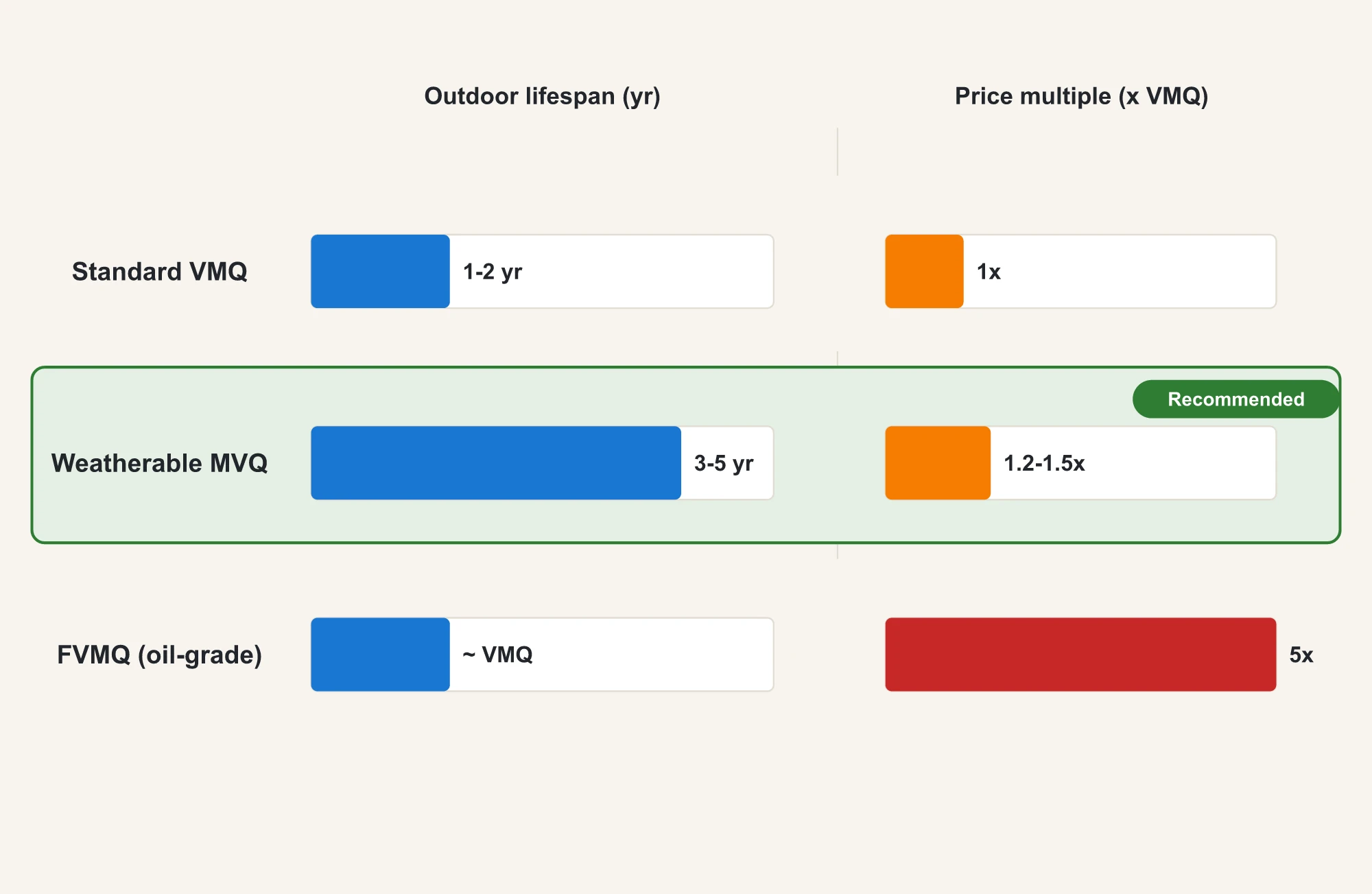
When does FVMQ justify its cost? Evaluate these four conditions:
| Selection Condition | Weather-Resistant MVQ Is Sufficient | FVMQ Is Required |
|---|---|---|
| Exposure to oil, solvents, or fuel vapor | No exposure | Long-term exposure to hydraulic oil, fuel vapor, or organic solvents |
| Outdoor UV intensity | Suitable from temperate to tropical climates | Not a deciding factor; FVMQ doesn’t provide better weather resistance than VMQ |
| Required service life | The correct additive package can provide three to five years | Weathering life is similar to VMQ; the advantage is longer overall service life in oil-exposed applications |
| Operating temperature | VMQ supports continuous service at about 200 °C | FVMQ has a temperature range similar to VMQ |
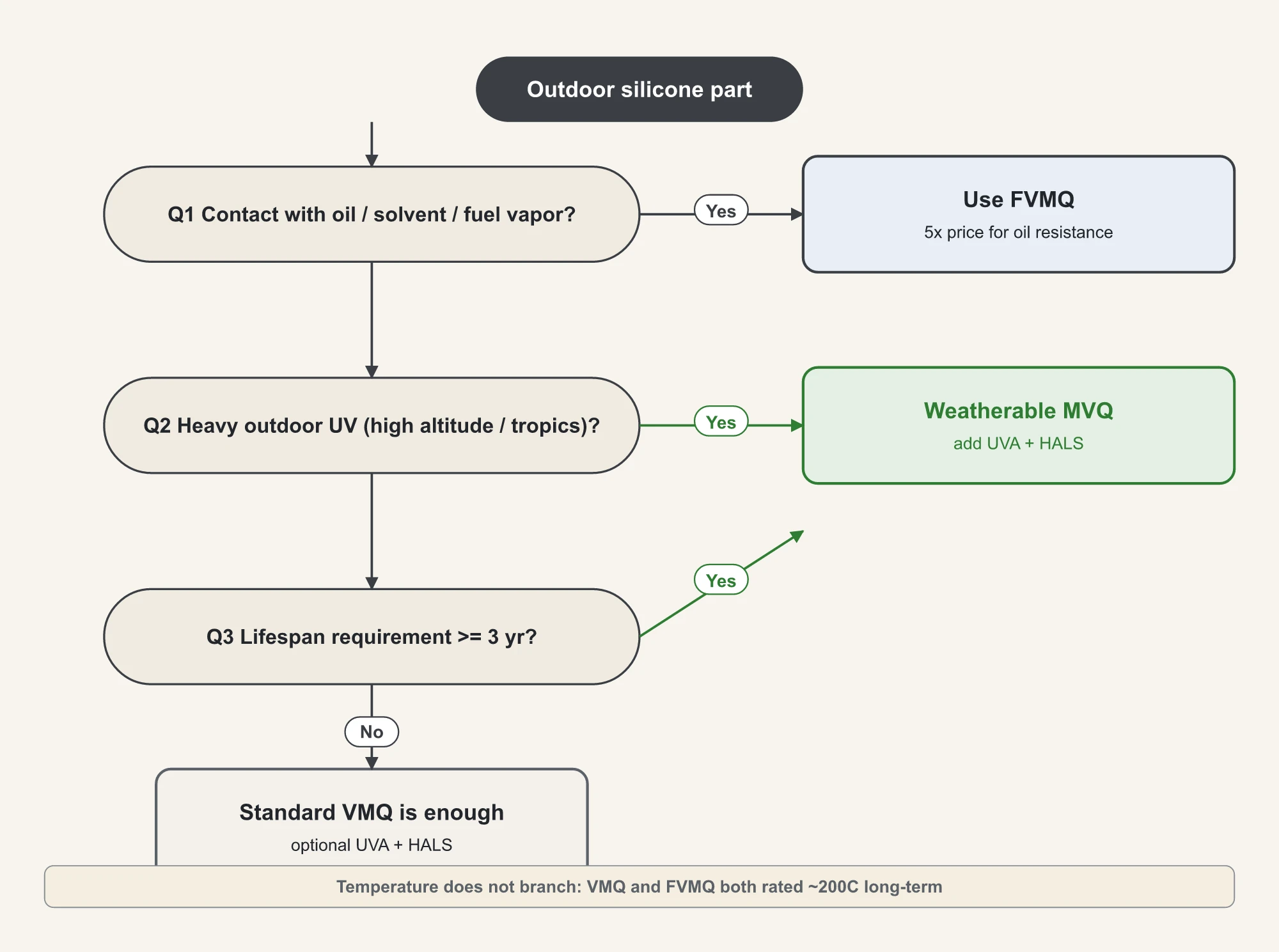
Most outdoor instrument applications don’t involve oils or solvents. Examples include radio antenna base pads, weather-station sealing rings, sensor interface seals, and outdoor enclosure Silicone Seal Strip components. Standard silicone with a weather-resistant additive package is sufficient, so there is no need to pay five times more for FVMQ. FVMQ becomes necessary in applications exposed to hydraulic oil, fuel vapor, or organic solvents.
Use Three Standards for Acceptance Testing
Three ASTM standards provide the key criteria for determining whether a part meets weather-resistant requirements:
| Aging Test | Standard | Test Conditions | Acceptance Threshold |
|---|---|---|---|
| UV aging | ASTM G154 | UVA-340 lamps; outdoor parts typically require 500 to 1,000 hours | No surface cracking; hardness change ≤10 Shore A |
| Ozone aging | ASTM D1149 | 50 pphm for 72 hours | Tensile property retention ≥80% |
| Hot-air aging | ASTM D573 | 200 °C for 168 hours | Hardness change ≤5 Shore A |
The technical requirements section of the drawing should state: This part is intended for outdoor use; the base polymer shall be VMQ, equivalent to MVQ; the formulation shall include UVA, specifically UV-327, and HALS, specifically Tinuvin 622; the reinforcing filler shall be fumed silica; a post-cure at 200 °C for two hours is mandatory; acceptance testing shall comply with ASTM G154, ASTM D1149, and ASTM D573.
Once these requirements appear on the drawing, the supplier can’t default to the cheapest General Purpose Silicone.
Outdoor hardening isn’t unpredictable. Check whether the formulation contains UVA and HALS, whether the parts received a post-cure, and whether acceptance testing followed the specified standards. These checks usually reveal the cause. If the choice between standard VMQ and FVMQ remains unclear, provide the operating conditions, including media exposure, UV intensity, required service life, and working temperature. YueHouDZ can determine whether the application needs weather-resistant MVQ or FVMQ and define the corresponding ASTM acceptance thresholds.
Frequently Asked Questions
Are bloom and hardening the same problem?
No. Bloom is a powdery or hazy deposit that migrates to the part’s surface. It falls into four categories:
- Curing-agent bloom: A gray-white powder with an alcohol or ketone odor. It usually results from a DBPMH dosage above 1.2 phr or from Undercure.
- Mold-release-agent bloom: A slippery white film that melts when exposed to hot air at 80 °C. Excess zinc stearate is a common cause.
- Silicone oil oligomer bloom: A cloudy or mottled deposit that returns after wiping. It results from the migration of low-molecular-weight D3 to D6 compounds.
- Additive bloom: A pale blue or gray-brown haze caused when the dosage of a single additive exceeds its solubility limit.
Bloom and hardening have different mechanisms, but both indicate a formulation or process problem.
Can UV stabilizers be added without changing the base polymer?
Yes. This is the correct approach for most outdoor parts. With the same VMQ base polymer, adding UVA and HALS can extend outdoor service life by three to five times. Retaining the base polymer and improving the additive package is the most cost-effective industrial route to better weather resistance. Switching to another base polymer, such as FVMQ, won’t solve hardening caused only by UV exposure because FVMQ and VMQ provide similar UV resistance.