The easiest way to mess up a custom silicone coaster project is to choose the wrong structure, leave the size unclear, or fail to confirm color and logo results in advance. This article explains the key steps “from idea to mass production” in a clear way: what information you need to prepare, how to choose common structures, and how to define the critical design parameters—so you can pass sampling faster and keep mass production more stable.
Common Silicone Coaster Structure Types
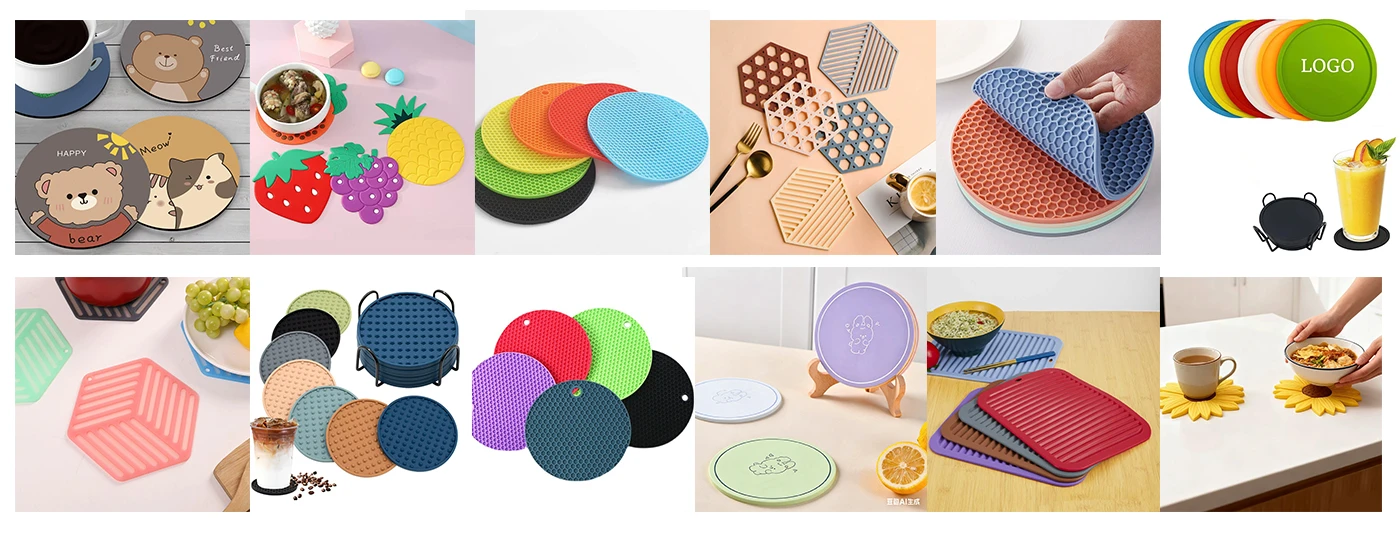
1) Form & Structure
- Flat Standard (2D): The most basic 2D design. Low cost, ideal for large-batch logo screen printing.
- Grooved Anti-Spill: With a raised “water dam” around the edge and honeycomb/grid channels inside—designed for cold-drink condensation control.
- 3D Raised Relief: 1.2–2.0 mm surface layering. Multi-color layered effect via a silicone dispensing (color-filling) process.
- Hollowed / Ventilated: Geometric cut-out design to reduce weight while improving thermal insulation efficiency.
- Foldable & Portable: Includes a thinned folding zone (~0.8 mm), suitable for outdoor carry and storage.
2) Performance Upgrades
- High-Grip Anti-Slip: Diamond texture or micro-suction features on the bottom, optimized for smooth surfaces such as glass.
- Thickened Anti-Warp: 5 mm+ thickness or embedded fiberglass mesh to reduce warpage on large-size coasters.
3) Visual Effects & Processes
- Special Color Effects: Gradient silicone injection, long-lasting glow-in-the-dark (strontium aluminate pigment), and thermochromic color-change designs.
- Refined Aesthetics: Laser-engraved textures, Instagram-style minimalist geometry, or Japanese/Korean cute cartoon styling.
4) Creative & Interactive Concepts
- Modular / Interlocking: Dovetail grooves or magnetic attachment; multiple pieces can connect into a larger placemat or hot-pot mat.
- Multi-Function Combo: Integrated bottle opener, phone stand, or built-in cup-holder structure.
- Emotional / Interactive: Zodiac collections, holiday limited editions, or a small edge groove designed for planting mini succulents.
What Silicone Coasters Do
- Heat insulation & burn protection: Isolates hot cups/kettles to protect the tabletop from burns, discoloration, and blistering.
- Anti-slip stability: Reduces sliding and spill risk (especially obvious in offices or homes with kids).
- Water stain prevention: Holds condensation and minor spills to reduce water rings on the table.
- Noise reduction & cushioning: Quieter placement and better protection for both cup bottom and tabletop.
- Easy to clean & durable: Less prone to tea/coffee/oil staining; easy to wipe and wash.
Core Performance Metrics for Silicone Coasters
- Temperature resistance: No deformation or odor with hot cups; no cracking in freezing conditions.
- Elastic recovery / anti-deformation: Recovers after compression; no edge lifting.
- Odor / VOC: No harsh smell when unbagged or heated.
- Aging resistance / anti-yellowing: No stickiness and minimal yellowing after long-term use.
- Compliance: Tests/reports can be provided per market needs, such as FDA / LFGB / REACH.
Who Should Customize Silicone Coasters
- Brands: Use as free giveaways/advertising items.
- E-commerce retail sellers: Design cute/creative coasters for sale.
- Restaurants: Use in-house for consistent service presentation.
- Brand giveaways: Focus on cost, logo presentation, and lead time.
- E-commerce retail: Focus on appearance details, packaging, and differentiated processes.
- Restaurant use: Focus on washability, oil resistance, anti-slip, and consistent dimensions.
What to Prepare Before Customizing Silicone Coasters
- Use scenario/goals (home, gift, food service, food-contact, kids, etc.)
- Size range (diameter or L×W, target thickness)
- Appearance requirements (number of colors, texture, anti-slip structure needed or not, logo method: embossed/debossed/printed)
- Artwork files (logo/pattern ideally in vector: AI / CDR / PDF)
- Material requirements (standard vs food-grade, low-odor, anti-yellowing, oil-resistant, etc.)
- Target compliance markets (FDA / LFGB / REACH)
Silicone Coaster Design Essentials
| Detail Category | Key Design Parameters / Recommendations | Problem It Solves |
|---|---|---|
| Anti-slip design | Bottom honeycomb grid + micro suction cups (Ø 5 mm/height 0.3 mm) | Prevents sliding on smooth tabletops. |
| Drainage / water control | 1) 0.5 mm radial grooves; add a few shallow vent grooves on the surface. 2) Raised outer lip: create a small “dam” around the perimeter. | 1) Anti-sticking: when lifting the cup, the coaster won’t get “sucked up” and follow the cup. 2) Anti-leak: holds condensation like a small tray so water doesn’t flow onto the table. |
| Size compatibility | Standard diameter: 9–10 cm; add a 6 cm concentric ring inside to fit smaller cups | Compatible with multiple cup-bottom sizes; 9 cm is a “golden size” for most cups. |
| Edge treatment | Add a 1.5 mm micro chamfer OR thicken the edge by 0.5 mm; use R-corners (rounded corners) | Prevents edge curling; avoids the sharp-edge “cutting” feel. |
| Storage / portability | Thin the folding area to 0.8 mm (about 30% thinner than the main body); design a stackable structure | Saves space and improves portability, while reducing cracking risk at the fold. |
| Material hardness | 50–60 Shore A | 40 Shore A is too soft and deforms easily; 70 Shore A is too hard and loses grip. 50–60 is a balanced “golden hardness” for support, durability, and anti-slip performance. |
| Cost optimization | Thickness around 2.5 mm | Reduces material cost and vulcanization (curing) cycle cost. |
| Pattern depth | Engrave depth 0.3–0.4 mm + line width > 0.3 mm | Ensures clear graphics without dust-trapping; lines that are too thin are hard to machine in the mold and will blur on the finished part. |
Production Feasibility Evaluation for Silicone Coasters
Before starting the design, please use the table below to evaluate whether the project is worth launching:
| Evaluation Item | Recommended to Customize (YES) | Not Recommended (NO) |
|---|---|---|
| First order quantity | > 500 pcs | < 500 pcs (many factories won’t take the order; unit price is extremely high—better to buy ready stock) |
| Estimated annual demand | Long-term demand or recurring reorders | One-time only, low volume, no follow-up |
| Customization goal | Brand giveaways, e-commerce hero product, restaurant VI standardization | Personal use, temporary party/one-off usage |
| Structural difficulty | No complex undercut structures | Sharp vertical right angles, ultra-fine cut-outs, many internal dead corners |
| Surface finishing processes | Recommended for large volume | Low volume: finishing vendors often won’t accept, or the price is very high even if accepted |
| Edge treatment | Rounded edges (R-corners) | Sharp edges (stress concentration can cause cracking) |
| Special components | All-silicone part | Embedded metal parts, multi-moving-part assemblies |
| Functional features | Standard food-grade, low-odor, high-temperature resistant | Conductive, thermally conductive, color-changing (expensive materials and very high MOQ) |
Common Questions About Silicone Coasters
What material should I choose for silicone coasters?
- Food service / kitchen / possible food & beverage contact: Choose FDA food-grade silicone (typical temperature range: -40°C to 230°C).
- Non-food contact / industrial use: Choose standard-grade silicone for lower cost.
What color standard should I provide for silicone coaster production?
Provide a Pantone color reference (C / Solid Coated) is sufficient.
After you send the Pantone code to the YueHouDZ factory, the factory will first make several silicone color samples close to that code for your confirmation. After you confirm, you will sign off on the color approval, and mass production will follow that Pantone C code. Once this process is completed, the color deviation is usually minimal.
What is the custom silicone coaster workflow?
- Submit requirements: size/quantity/color (Pantone) / food-grade or not / logo process
- Provide files: AI / EPS / CDR artwork
- Quotation confirmation: unit price + mold/tooling cost + lead time
- Sampling: make samples for you to review the result
- Sample sign-off: confirm color, logo, and tactile feel before mass production
- Mass production + QC + shipment (typically production starts after deposit; balance is paid before shipment)
If I can’t design and only have an idea, can I still customize silicone coasters?
Yes. In general, as long as you meet the minimum order quantity (usually 500 pcs+), many silicone product factories are willing to provide free assistance with drawing/3D modeling. You only need to provide approximate dimensions (diameter or L×W, thickness, logo position, etc.) and a simple sketch or reference image so the factory can quickly understand your idea and move into sampling faster. YueHouDZ offers the same for silicone coasters: once the MOQ is met, free 3D modeling support is available.