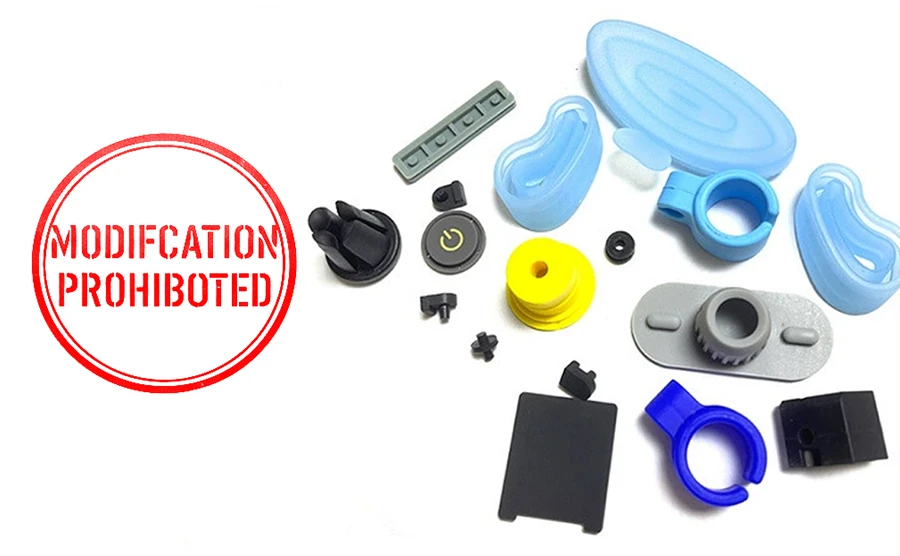
During the prototyping (sampling) stage of custom silicone products, some factories may privately modify customer dimensions or remove design details without authorization. These changes may look minor, but they can directly cause the product to deviate from its original design intent and affect functional performance (e.g., reduced sealing performance or lower assembly accuracy). They may even lead to delivery delays, inspection/acceptance disputes, and other issues, resulting in unnecessary time and cost losses for customers. This content is compiled from YueHouDZ’s practical experience in custom silicone product projects, for your early-stage evaluation and reference.
Direct to the Point: The “Hidden Risks” of Unauthorized Factory Modifications
According to industry research, some disputes in custom silicone prototyping are caused by factories modifying designs without customer approval. This behavior typically appears in two forms: (1) adjusting critical dimensions without permission (such as hole diameter, wall thickness tolerances), and (2) removing non-structural details (such as textures, markings/logos). In real projects, we have encountered cases where a factory removed sealing-groove details, resulting in water leakage after assembly and causing rework. These operations are often described as “manufacturing optimization,” but they may actually introduce functional defects, acceptance disputes, and even contract disputes.
System First: Contract Controls and Sample-Sealing Standards Build a “Protective Wall”
The key to preventing unauthorized modifications is to establish a proactive constraint mechanism. By signing a formal contract, clearly stipulate that “any modifications involving product dimensions, structure, or details must receive the customer’s written approval,” and define breach clauses (such as responsibility for rework costs and delivery-delay compensation). At the same time, implement a sample-sealing (golden sample) system: before prototyping, both parties confirm the design drawings; after completion, physically seal and retain the approved sample (with parameter records attached) as the sole standard for mass production and acceptance/inspection. This mechanism clarifies responsibilities at the source and blocks unauthorized factory changes from occupying operational space.
Process Control: An Engineering Change Request (ECR) Makes Every Change “Traceable”
A standardized process is essential to eliminating unauthorized modifications, and the “Engineering Change Request (ECR)” is the core tool. In accordance with standard industry practice, before making any change, the factory must submit an ECR containing three key items: the specific revised values (e.g., hole diameter adjusted from φ5.0 mm to φ5.2 mm), the reason for the change (e.g., dimensional deviation caused by material shrinkage rate), and an impact statement (e.g., changes to cost and lead time). Only after the customer signs and confirms can the factory execute the change. This process ensures transparency, giving the customer the right to be informed and the authority to decide on every adjustment.
Conclusion
To address the risk of unauthorized factory modifications during custom silicone prototyping, customers should establish a dual protection system of “system + process”: build an institutional defense line through contracts and sample-sealing (golden sample) standards, and regulate all modifications through an ECR workflow. When these two measures work together, they can effectively ensure the customized product meets design requirements and make prototyping a true “accelerator” for product launch.
- Dimension callouts on drawings should clearly define tolerance ranges (e.g., ±0.1 mm).
- When sealing the approved sample, record a 360° detailed video for traceability and archiving.
- The ECR should include before-and-after comparison images for the change.