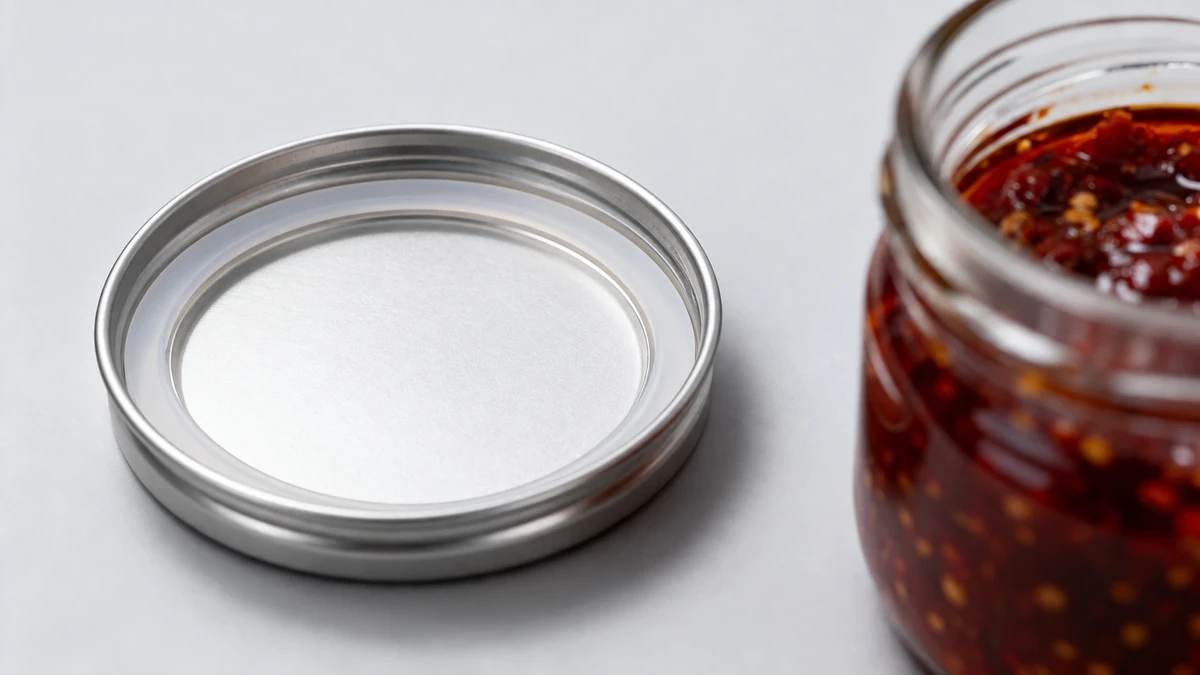
When specifying a gasket for a new jarred food product, suppliers often provide a food contact report and declare, “This is food grade silicone.” You need to review the report, but it only proves the tested formulation complies with specific regulations, samples, and laboratory conditions. It does not answer whether the material can handle your chili oil, vinegar brine, or spicy sauce over a long shelf life.
Compatibility involves more than checking if an immersed piece of silicone cracks. Food ingredients can penetrate the silicone matrix, causing the gasket to swell and soften. Conversely, the liquid can extract migratable components from the material, leading to shrinkage or hardening. When these dimensional changes occur inside a jar lid, they interact directly with assembly compression, groove clearance, and shelf-life requirements. Follow a four-gate verification sequence: verify regulatory scope, prescreen raw material data, test against actual recipe formulations, and validate sealing and sensory performance on fully assembled lids.
A Food Contact Certificate Is Only an Entry Ticket
“Food grade” is not a universal certificate that covers every food matrix and processing condition worldwide. Regulations in the United States, Germany, and China differ in scope and test protocols. The material grade, durometer, color, curing system, contact temperature, and intended use listed on the test report must match your mass-production specifications.
US FDA 21 CFR 177.2600 covers rubber articles intended for repeated use. The regulation lists permitted substances and mandates extraction tests based on food types. Finished articles contacting aqueous foods undergo distilled water reflux extraction. Articles contacting fatty foods undergo n-hexane reflux extraction. The protocol requires an initial 7-hour extraction followed by a secondary 2-hour extraction with fresh solvent, each with specific extractable limits. Passing this test proves compliance under statutory test conditions. It does not replace real-time storage testing with your actual hot sauce, juice, or spice formulation.
Germany’s BfR Recommendation XV (Silicones) represents guidance from a risk assessment authority rather than statutory German law. For silicone elastomers, BfR XV sets specific thresholds: volatile organic compounds (VOC) must not exceed 0.5%, extractables must stay below 0.5%, and finished articles must pass peroxide testing with negative results. Sensory testing provides another verification metric for packaging, but DIN 10955 sensory testing is separate from these three chemical requirements.
Chinese standards require careful version verification. GB 4806.11-2023 removed silicone rubber from its scope. GB 4806.16-2025, which applies specifically to food contact silicone materials and articles, took effect on September 2, 2026. Verify compliance documents against the sales destination, intended use, and active standards. Never rely solely on an “FDA,” “LFGB,” or generic “Food Grade” label on a report cover.
| Verification Gate | What It Answers | What It Cannot Replace |
|---|---|---|
| Regulations & Standards | Confirms the specific formulation, sample, and conditions meet applicable statutory limits | Long-term material behavior in actual food formulations |
| Material Documentation | Verifies grade, curing system, color, and supplier declarations match submitted samples | Seal retention after lid assembly |
| Project Compatibility Tests | Tracks changes in dimensions, mass, hardness, and appearance under actual or worst-case recipes | Untested temperatures, storage times, or revised recipes |
| Assembled Lid Verification | Checks for leakage, flavor scalping, and opening torque under real assembly conditions | Other jar designs or raw material batches |
These four verification gates do not substitute for one another. Regulatory compliance is the baseline requirement to proceed, while compatibility testing and assembled lid verification determine whether the Silicone Gasket is ready for production sign-off.
Oil-Based and Fatty Contents
Stating that “silicone resists oil” only means the polymer family offers baseline resistance. It does not guarantee a specific formulation will tolerate a specific oil long-term. Edible oils vary in fatty acid profiles, and seasoned oils often contain spice extracts, alcohol, or solubilizers. Higher processing temperatures and extended contact times alter test results significantly.
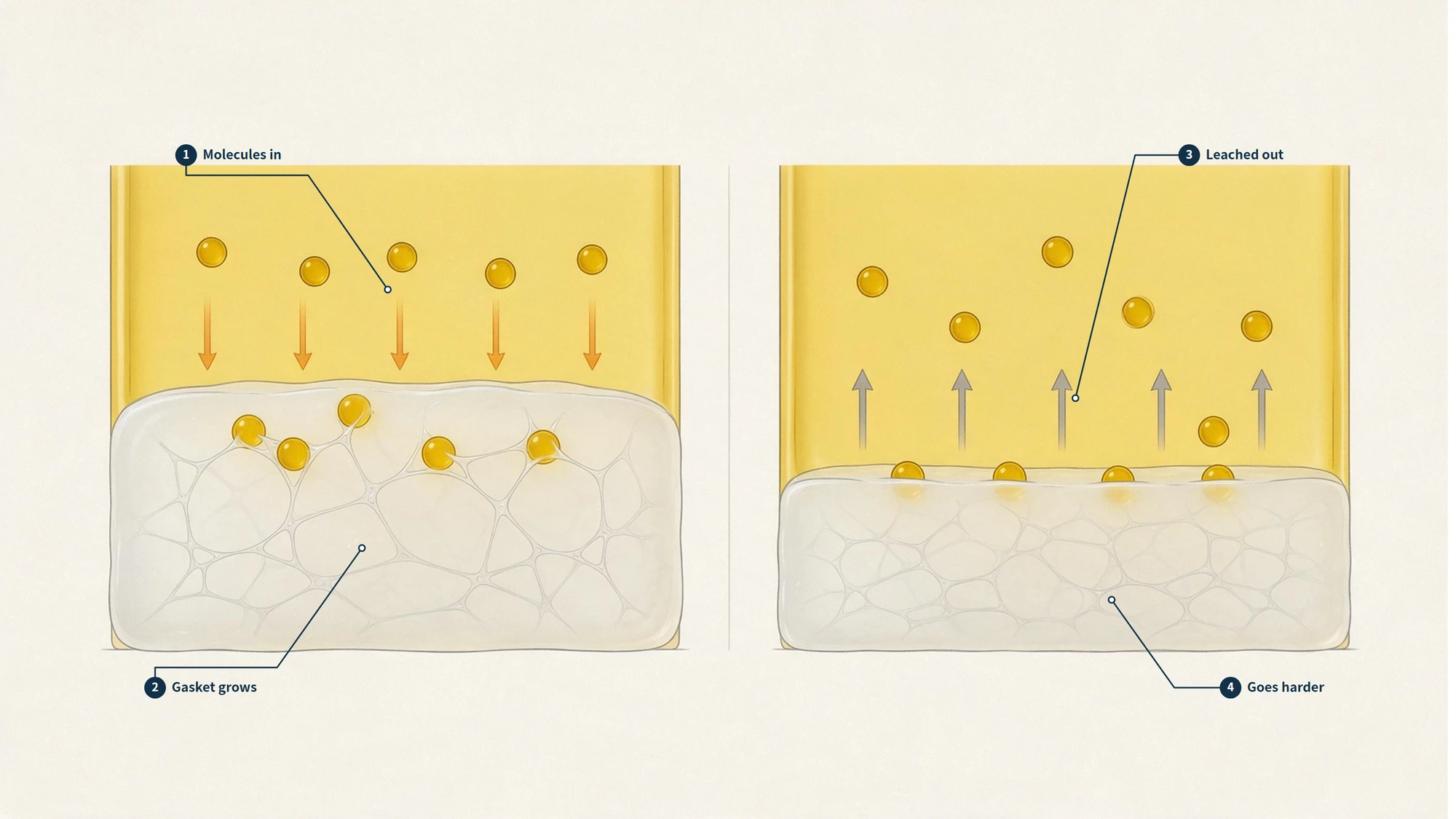
Silicone typically reacts to oils through two mechanisms. First, swelling occurs when liquid penetrates the silicone polymer network, causing the gasket to expand and soften. Second, extraction occurs when the liquid strips out certain components from the silicone, altering mass, volume, or hardness. Both mechanisms can occur simultaneously. Never rely solely on post-immersion diameter or evaluate hardness changes by touch.
Material compatibility charts use A, B, C, and D ratings to rank chemical resistance. These charts help filter out obvious high-risk fluids, but they represent initial vendor screening under specific laboratory conditions—not an industry-wide universal standard. Even under the label “silicone,” differences in base polymer, fillers, color masterbatches, peroxide cure or platinum cure systems, and post-cure protocols yield different physical outcomes. If a chart omits exact test specimens and parameters, do not copy those letter grades into your acceptance criteria.
Treat rule-of-thumb limits for volume and hardness with equal caution. Many sealing handbooks consider volume changes under 10% acceptable, flag changes over 20% as high risk, and define hardness shifts within ±5 Shore A as minor. These numbers serve as starting points for test design, not universal pass/fail thresholds for jar gaskets. Handbook data often applies to dynamic seals or Silicone Rubber O-Rings in hydraulic systems. Jar lids must account for groove clearance, assembly compression, food safety, and shelf life. Set true acceptance criteria based on product risk, historical validation, raw material supplier guidance, and standardized lab methods.
Compare mass, volume, hardness, and visual appearance before and after exposure. Then, assemble the aged gasket into an actual lid. A gasket might show negligible dimensional change but suffer a major drop in hardness, losing its sealing force. Even if material lab numbers look stable, fail the part if the assembled jar leaks, shows abnormal opening resistance, or picks up off-flavors from oil migration.
Evaluating Acids and Spices Separately
Do not group acidic foods by pH alone. Pickling brines, fruit juices, and sour chili sauces differ widely in acid types, acid concentration, salt, sugar, oil content, and spices. Two foods with identical pH levels can interact with silicone in completely different ways. Silicone resists certain dilute organic and inorganic acids well, but that does not predict how it behaves in complex food acid matrices. Track hardness, mass, volume, surface stickiness, and micro-cracking; actual results depend on the full formulation and test environment.
Spices and essential oils behave differently from standard edible oils. They are complex multi-component mixtures containing terpenes, alcohols, aldehydes, and esters. Some active compounds penetrate the silicone matrix, while others adsorb onto the surface, causing swelling, material degradation, or persistent odor retention. Do not disqualify all spices just because one component showed a low rating on a general chart. Evaluate material changes against your exact recipe and test conditions.
Set up a dedicated sensory evaluation group. A gasket that survives immersion without cracking can still impart off-odors or scalping flavors from the food. Conversely, a noticeable aroma does not automatically mean chemical migration limits are exceeded. Run comparative sensory evaluations with two groups: a blank food sample without gasket contact, and a test group in contact with the candidate gasket. Standardize the containers, contact temperature, duration, post-opening equilibration time, and sensory protocol. Leave chemical migration and food-contact compliance tests to accredited third-party laboratories.
Post-cure baking helps remove volatile organic compounds and residual low-molecular-weight siloxanes, but it does not guarantee zero flavor transfer. If standard silicone grades degrade or swell excessively in aggressive spice matrices, consider FVMQ (Fluorosilicone Rubber) as a candidate for higher oil and solvent resistance. However, you must re-verify FVMQ for food contact compliance, processing conditions, cost, compression performance, and actual content compatibility.
| Content Category | Required Specimen Details | Primary Observation Metrics | Unsubstantiated Assumptions |
|---|---|---|---|
| Edible oils and oil-preserved foods | Oil type, formulation, presence of spice extracts, filling and storage temperatures | Mass, volume, hardness, appearance, assembled lid seal integrity | “All food grade silicone is oil resistant” |
| Acidic complex foods | Actual or worst-case acid profile, salt/sugar/oil ratios, pH, temperature | Hardness, mass, volume, surface tackiness, cracking | Predicting material behavior purely on pH |
| Spices, flavorings, or essential oil systems | Complete recipe or representative worst-case formulation, concentrations, carrier solvents | Material swelling/shrinkage, flavor transfer, assembled lid seal integrity | “A single low rating on a chart invalidates the entire material class” |
Will the Gasket Still Seal After Exposure?
Passing an immersion test only confirms the material changed within acceptable limits under those specific test conditions. In production, a jar gasket stays compressed between the lid and the glass or metal rim. It must withstand temperature swings, transit vibration, and repeated opening/closing cycles while maintaining sealing force. You must link fluid compatibility data to structural mechanical calculations.
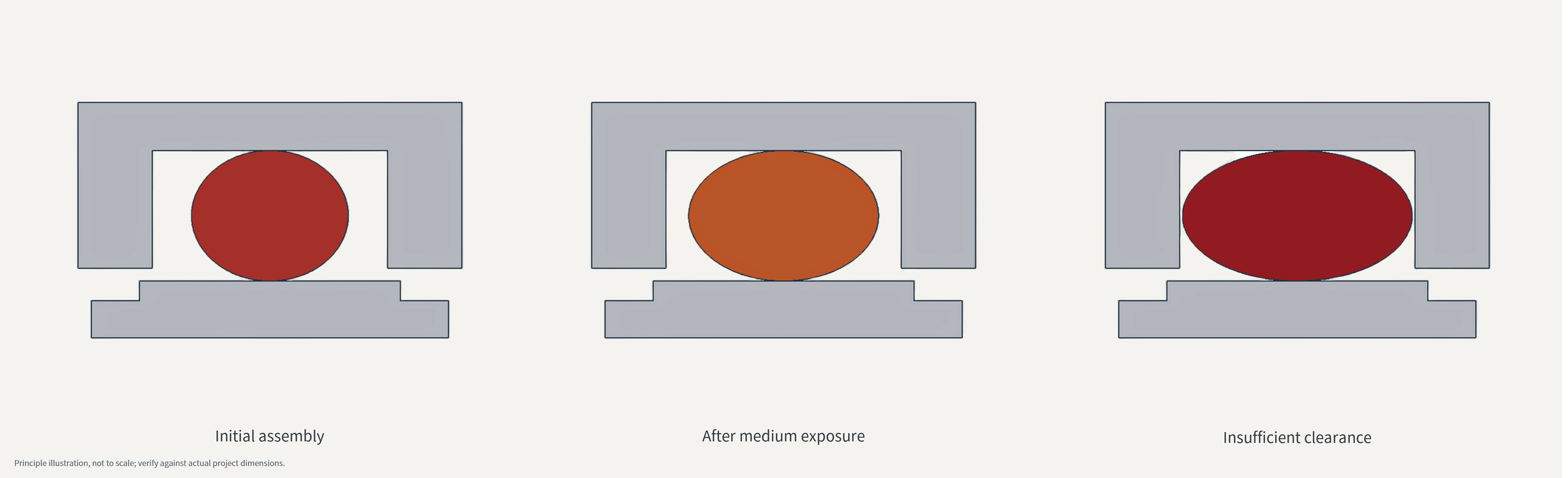
Clarify three core engineering concepts:
- Compression Rate (Squeeze %): The percentage of gasket cross-sectional height compressed during assembly.
- Groove Fill Rate: The percentage of available gland/groove volume occupied by the gasket cross-section.
- Compression Set: The permanent deformation remaining after compressive stress is released over time.
Compression rate and groove fill define the physical assembly geometry; compression set measures material elastomeric recovery. Do not blend these into a single metric.
Standard O-ring design guides often recommend a 15% to 25% squeeze for static seals and a maximum groove fill around 85%. These guidelines apply to standard circular elastomer cross-sections under specific gland geometries. Jar packaging uses flat die-cut or molded gaskets, custom profile seals, foamed liners, snap-fit caps, and thin-walled glass or metal rims with wide tolerances. Calculate your minimum and maximum compression states at worst-case dimensional tolerances, then recalculate clearances using the swelled or shrunken gasket dimensions from your fluid immersion test.
ASTM D471 and ASTM D395 are distinct test methods. ASTM D471 evaluates rubber property changes after liquid immersion; ASTM D395 measures compression set in air or specified media. You can combine both in a validation plan, but never use a specimen already degraded or altered by one test to report results for the other. Prepare independent test specimens from the same production batch: one group for D471 fluid aging, a second group for D395 compression set, and a third conditioned group (pre-soaked then compressed) to simulate real-world combined stresses. State the standard, exact test parameters, and project acceptance limits separately in test reports.
Standard references often cite ASTM D395 Method B conditions like 25% deflection at 70°C for 22 hours, alongside rule-of-thumb target percentages. These figures only make sense within their defined test setup, specimen geometry, and application envelope. Similarly, while high-temperature accelerated aging speeds up prescreening, treat it strictly as a risk screening tool. Without a validated time-temperature extrapolation, you cannot claim short-term accelerated aging directly equals months or years of real-time shelf life. Always validate production readiness using actual or worst-case food recipes, final jar packaging, and target storage conditions.
Drafting a Complete Validation Protocol Before Sampling
To avoid costly tooling revisions and project delays, do not just request another generic certificate from your Silicone Product Supplier. Draft a clear validation protocol specifying what to test, how to test it, and how to evaluate pass/fail criteria. Use the checklist below as a starting framework before initiating testing with your molder and testing lab:
| Parameter / Task Item | Required Information |
|---|---|
| Product & Application | Product name, target market, single-use vs. repeat contact, hot-fill requirements, expected open/close frequency |
| Actual Formulation | Full production recipe name or version; if proprietary, brand defines a representative test media |
| Worst-Case Formulation | Highest-risk recipe: peak oil/acid/spice concentration, highest filling temperature, or longest shelf life with documented rationale |
| Gasket Material Specs | Grade name, durometer (Shore A), color, cure system (platinum vs. peroxide), post-cure cycle, raw material manufacturer |
| Batch Traceability | Gasket lot number, molding date, mold/cavity ID, lid and jar production batch numbers |
| Test Groups & Sample Size | Blank control, actual formulation, worst-case formulation, alternative material baseline; record agreed sample quantities per group |
| Exposure Method | Full immersion, single-sided liquid contact, or assembled jar storage; state whether testing under assembly compression |
| Temperature & Duration | Target filling, transit, and shelf-life conditions; label accelerated thermal tests as “Screening Only” |
| Conditioning & Recovery | Post-test wiping procedure, ambient stabilization environment, and recovery duration prior to measurement |
| Material Measurements | Pre- and post-exposure mass, volume/dimensions, Shore A hardness, visual inspection for tackiness or micro-cracking, with test equipment listed |
| Compression Properties | Specific ASTM D395 method, specimen geometry, deflection %, temperature, and duration using independent batch specimens |
| Sensory Evaluation | Odor/flavor comparison against blank control, container type, holding time, and sensory panel / analytical lab method |
| Assembled Lid Sealing | Leak testing, inverted storage, pressure retention, and opening torque on assembled lids; document pass/fail thresholds |
| Acceptance Criteria & Sources | Define whether limits derive from regulations, industry standards, internal specs, or OEM agreements; avoid vague terms like “industry standard” |
| Sign-off & Reporting | Raw data, photos, deviations, sample retention, and authorized sign-offs with dates from brand, molder, and testing lab |
Keep three data levels distinct on this protocol. Standard test methods define specimen prep, test procedure, and calculation formulas. Test conditions specify the fluid media, temperature, exposure time, and compression level. Project acceptance limits determine what dimensional and mechanical changes pass your functional criteria. An ASTM standard gives you the test method, but it does not necessarily set the pass/fail values for your specific product. Stating “tested per ASTM, passed” without context leaves engineering teams blind if a field leak occurs later.
When producing custom silicone products for food packaging, YueHouDZ helps packaging engineers define test parameters based on actual food media, filling temperatures, contact styles, and gland geometry. We manufacture prototype and production samples using verified compounds, support customer and third-party laboratory testing, and provide raw material documentation. YueHouDZ does not replace legal counsel for multi-market food contact regulatory approvals, nor do we treat raw material certificates as a substitute for actual fluid compatibility testing. Production sign-off requires verified material physical data, sensory assessments, and assembled lid leak tests.
A food contact certificate is the first gate, not the finish line. When a vendor claims a gasket is “food grade silicone,” ask three direct questions: Does this test report match the exact raw material grade and cure system used in mass production? What dimensional and hardness data exists under my actual or worst-case recipe? How does the gasket perform in the assembled jar lid to guarantee zero leakage and zero flavor scalping? When you have test data answering all three, your jar gasket is ready for production tooling.