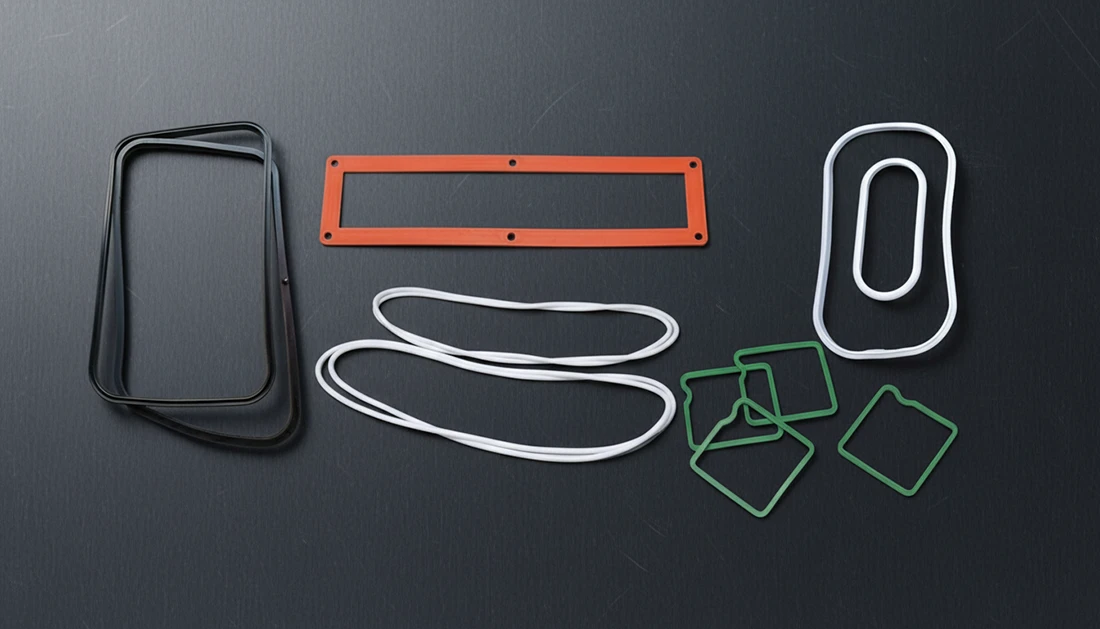
An oven door gasket may look small, but it is a core component for temperature control and operational safety. We’ve seen many common mistakes: standard silicone gaskets deform and start leaking after about 3 months, causing unstable oven temperature and poor baking results; some users force-fit the wrong size and end up bending the oven door frame; and in worse cases, buyers pay more but receive gaskets made from recycled compound, which can release unpleasant odors when heated—creating potential safety concerns. The good news is that most of these issues can be avoided if you prepare properly before customizing. Below are five practical tips to help you get a durable and safe oven gasket.
Pitfall 1: Wrong Material = Wasted Effort! Heat Resistance + Safety Must Both Meet the Standard
Standard silicone (heat resistance around 150°C) may deform or harden in as little as 3 months under typical oven operating conditions of 180°C+. That leads to sealing failure and temperature leakage. For customization, you should choose materials rated for 200°C or higher. In practice:
- Fumed silicone (high-purity silicone rubber): heat resistance typically 200–220°C, with better purity and stable high-temperature performance—suitable for everyday household ovens.
- Fluorosilicone (FVMQ): heat resistance up to 250–300°C, with stronger aging resistance—ideal for commercial high-temperature ovens or long-term continuous high-heat scenarios.
Safety matters even more. The gasket is directly exposed to hot air; if recycled compound or non-food-grade silicone is used, harmful substances may be released during heating. Always request food-grade compliance (e.g., FDA, LFGB) and ensure the material contains no plasticizers and no heavy metals. Also, require that the property retention after hot-air aging is ≥80%. We’ve handled many replacement cases where customers reported: “After switching to high-temperature silicone, it stayed stable for over a year with no deformation, and the odor disappeared.”
Pitfall 2: A Tiny Dimensional Error Can Ruin the Seal — Control Tolerance & Measurement Accuracy
“I forced the wrong size and bent the door frame”—this is a widespread complaint. Key gasket dimensions (e.g., inner diameter, cross-section diameter) directly determine sealing and installation fit. A 0.5 mm difference may cause air leaks; a 1 mm difference can jam the installation or even damage the door frame.
For customization, define tolerance requirements clearly: the allowable deviation for inner diameter and cross-section diameter should be ≤ ±0.2 mm. Do not place an order based on “approximately the same as the original.” We recommend removing the original gasket for accurate measurement:
- Use a digital vernier caliper (resolution 0.01 mm) to measure the cross-section diameter.
- Use laser scanning (accuracy ±0.05 mm) to capture the overall geometry and key dimensions.
- Or send the original part to the supplier for 3D scanning and reverse engineering (3D scan replication).
We’ve seen customers quote dimensions from memory, only to find the new gasket came out smaller by one full “ring,” causing rework and wasted lead time. Accurate measurement is always the first step.
Pitfall 3: Process Details Decide Service Life — Pay Attention to Joint, Molding & Structural Design
Have you seen gaskets cracking at the joint or forming surface blisters? In most cases, the process was not done correctly. A gasket made by manual butt-joining can crack at the joint under high temperatures. In contrast, a one-piece molded gasket can reduce the risk of cracking by about 90%. For customization, prioritize one-piece compression molding + vulcanization (heat-cured solid silicone) to ensure there is no spliced seam, and require:
- Tear strength ≥ 30 kN/m (common GB requirement is ≥ 25 kN/m), to avoid frequent replacement.
Also, the structure should prevent shifting. If a gasket “walks” or shifts after installation, it often lacks a positioning feature. Ask the supplier to add small ribs (bumps) or a groove profile on the inner side to match the door frame channel and prevent sliding. We once optimized a gasket by adding a 0.5 mm positioning rib, solving the problem of “having to manually reset it after each bake.”
Pitfall 4: Supplier Risks Are the Biggest — Confirm Test Reports & Small-Batch Customization
The appliance spare-parts market varies widely in quality. Some suppliers use standard silicone to pretend it’s a high-temperature material; they may verbally claim “250°C rated” but cannot provide a test report. Others require thousands of pieces as MOQ, forcing small-batch buyers to purchase expensive off-the-shelf items.
When selecting a supplier, focus on two must-haves:
- Small-batch customization support (e.g., MOQ starting from 500 pcs) so you can verify size and performance before mass production.
- Authoritative test reports, especially results from 200°C × 1000-hour aging tests, to confirm whether the material will crack or harden under long-term high temperature.
We support small-batch customization (MOQ 500 pcs) for this exact reason: to help customers validate before scaling up, and avoid large-scale waste.
Pitfall 5: If You Don’t Check the Key Specs, You’re Ordering Blind — Performance Must Be in Writing
Don’t judge by “looks similar.” Some gaskets look fine but lose elasticity within one month because critical performance indicators are not met. Always request a test report and confirm these three items:
- Compression set: ≤ 25% (under 150°C × 70h). Lower compression set means better rebound after long-term compression and longer-lasting sealing.
- Tensile strength: ≥ 7.0 MPa. If too low, the gasket tears easily.
- Hot-air aging performance: hardness change ≤ ±10 Shore A, and tensile strength retention ≥ 80%, to ensure stability at high temperature.
Summary: Remember These 5 Key Points When Customizing an Oven Door Gasket
- Material: Heat resistance 200°C+ (household: fumed silicone 200–220°C; commercial/high-temp: fluorosilicone 250°C+) + food-grade compliance (FDA/LFGB).
- Dimensions: tolerance ±0.2 mm; measure with a digital vernier caliper (0.01 mm) or laser scanning (±0.05 mm).
- Process: one-piece molding (no joint) + positioning features (anti-shift).
- Supplier: supports small-batch customization (MOQ 500) + provides high-temperature/performance test reports.
- Specs: compression set ≤ 25%, tensile strength ≥ 7.0 MPa, tear strength ≥ 30 kN/m.
RFQ Checklist (Prepare Before Customization)
- Oven model / application (household / commercial).
- Gasket dimensions (inner diameter, cross-section diameter, tolerance requirements).
- Target temperature range (standard 200°C / high-temp 250°C+).
- Order quantity (sample / small batch / mass production).
- Certification requirements (FDA / LFGB, etc.).
- Special requirements (positioning features, surface texture, etc.).